IADR Abstract Archives
Self-etching Glass-ceramic Primer: Shear Bond Strength With Monobond Etch&Prime
Objectives: Etching of intaglio surfaces of lithium disilicate crowns with hydrofluoric acid(HF) is commonly performed to partially dissolve the glassy phase and create microporosities to enhance adhesion. This is followed by application of a silane coupling agent. However, etching with HF is cause for concern due to its hazardous potential. We compared shear bond strengths resulting from conventional etch & silanate methods to use of a recently introduced self-etching ceramic primer.
Methods: Thirty IPS e.max CAD sections (Ivoclar Vivadent, Amherst, NY) were cut, fired using manufacturer’s crystallization program, embedded in acrylic, and wet polished through 600 grit. Blocks were randomly assigned to three groups. Groups 1 and 2 were etched with 4.7%HF for 20 seconds, followed by thorough rinsing with water and air dried. Group 1 had Monobond Plus (Ivoclar Vivadent), silane coupling agent applied with a brush and allowed to react for 60 seconds. The excess was dispersed with air to ensure solvent removal. Groups 2 and 3 had Monobond Etch & Prime (Ivoclar Vivadent)(MEP), single-component etch/primer, applied and scrubbed into the surface for 20 seconds, were allowed to react for an additional 40 seconds and were thoroughly rinsed with water and air dried. An Ultradent jig (South Jordan, UT) was used to place 2 Multilink Automix (Ivoclar Vivadent) 2mm-high posts onto each of the samples in all three groups(N=20 each). Posts were light cured for 20 seconds and stored for 24 hours at 37°C (100% humidity). Shear bond strength was measured with an Electropuls E-3000 (Instron, Norwood, MA) using a crosshead speed of 0.5mm/min. ANOVA (post-hoc Tukey) was used to compare bond strengths (α=0.05).
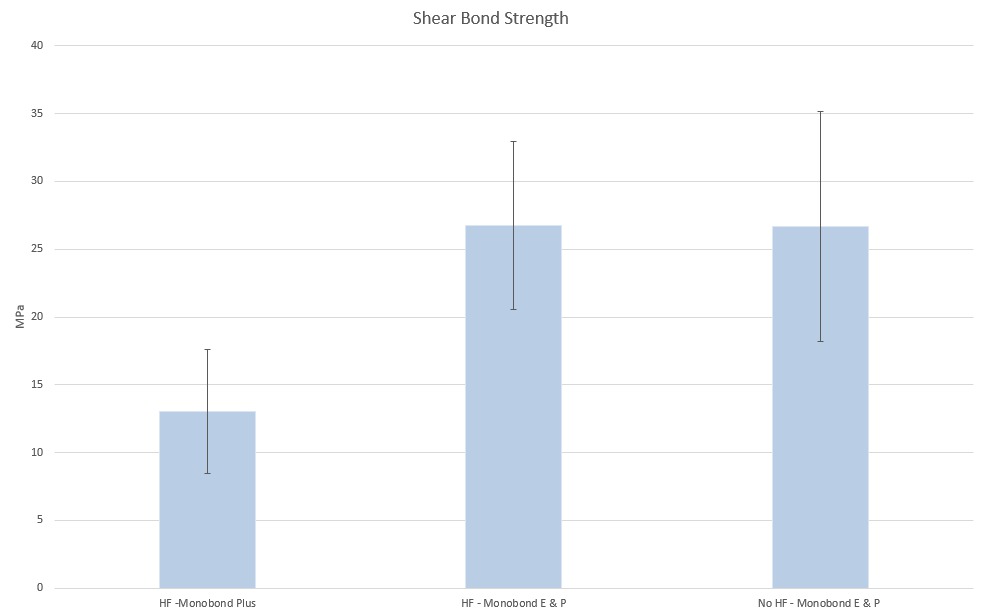
Results: Samples prepared using MEP had significantly stronger shear bond strength compared to traditional HF-etch and separate silane treatment- see graph.
Conclusions: The simplified one-step MEP may be a superior method to prepare ceramic surfaces prior to bonding.
Methods: Thirty IPS e.max CAD sections (Ivoclar Vivadent, Amherst, NY) were cut, fired using manufacturer’s crystallization program, embedded in acrylic, and wet polished through 600 grit. Blocks were randomly assigned to three groups. Groups 1 and 2 were etched with 4.7%HF for 20 seconds, followed by thorough rinsing with water and air dried. Group 1 had Monobond Plus (Ivoclar Vivadent), silane coupling agent applied with a brush and allowed to react for 60 seconds. The excess was dispersed with air to ensure solvent removal. Groups 2 and 3 had Monobond Etch & Prime (Ivoclar Vivadent)(MEP), single-component etch/primer, applied and scrubbed into the surface for 20 seconds, were allowed to react for an additional 40 seconds and were thoroughly rinsed with water and air dried. An Ultradent jig (South Jordan, UT) was used to place 2 Multilink Automix (Ivoclar Vivadent) 2mm-high posts onto each of the samples in all three groups(N=20 each). Posts were light cured for 20 seconds and stored for 24 hours at 37°C (100% humidity). Shear bond strength was measured with an Electropuls E-3000 (Instron, Norwood, MA) using a crosshead speed of 0.5mm/min. ANOVA (post-hoc Tukey) was used to compare bond strengths (α=0.05).
Results: Samples prepared using MEP had significantly stronger shear bond strength compared to traditional HF-etch and separate silane treatment- see graph.
Conclusions: The simplified one-step MEP may be a superior method to prepare ceramic surfaces prior to bonding.
IMAGES
2632640_File000000.jpg
2632640_File000000.jpg