IADR Abstract Archives
New Ion-releasing Highly-polishable Flowable Restorative Material Containing Nano S-PRG Filler
Objectives: Strength of flowable composite resins has been improved for posterior restoration. New clinical demands for such composites include higher polishability for better aesthetics. Refining our Pre-Reacted Glass-ionomer (PRG) technology, we have successfully nanosized S-PRG filler to develop a novel nano S-PRG filler-containing ion-releasing flowable composite resin for anterior/posterior restoration. This study aimed to evaluate effects of nano S-PRG filler in the novel flowable composite resin on its physical properties (polishability, acid-neutralizing capacity).
Methods: We prepared novel nano S-PRG filler-containing flowable composite resin SI-R21510 (SI, Shofu). As a control, submicron S-PRG filler-containing flowable composite resin (CONT, Shofu) was prepared. For polishability testing, disc-shaped specimens (15mm-diameter, 2mm-thickness) of cured resin pastes were polished using #320-grit SiC paper, followed by Super-Snap X-Treme (Shofu). Gloss of polished surfaces was measured (60°) using a glossmeter. For acid-neutralizing evaluation, disc-shaped specimens (15mm-diameter, 1mm-thickness) of cured resin pastes were separately immersed in lactic-acid solution (5mL, pH=4.0), and time-dependent pH change in the solution was measured (24h) using a pH meter. For comparison, commercially-available flowable composite resins Filtek Supreme Ultra Flowable (UF, 3M ESPE) and Tetric EvoFlow (EF, Ivoclar Vivadent) were used. Data were statistically analyzed (one-way ANOVA, Tukey's).
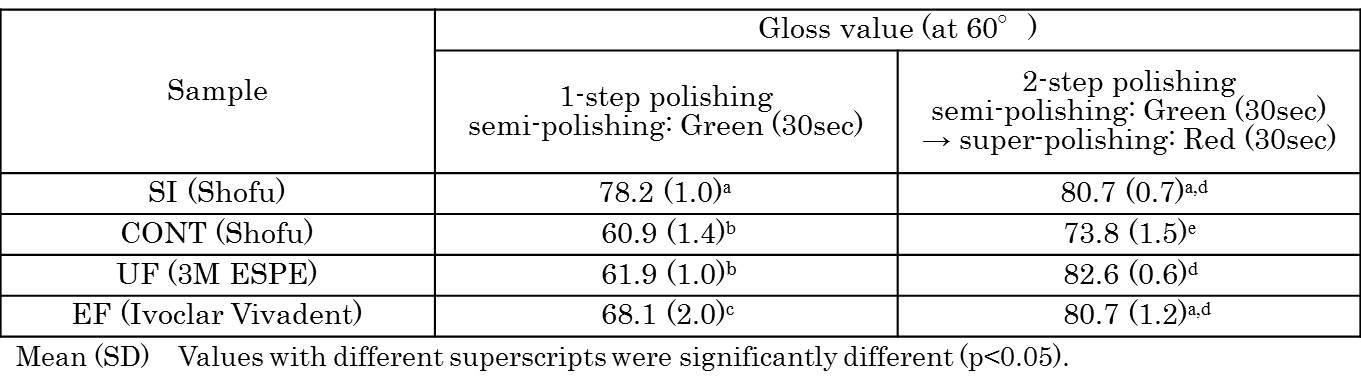
Results: With nano S-PRG filler added, SI had higher gloss values than CONT for both (1-step/2-step) polishing methods (p<0.05). SI’s gloss value for the simple 1-step method was as high as that for the 2-step method.
SI exhibited acid-neutralizing behavior similar to that of CONT.
Conclusions: SI’s high gloss obtained by even the simpler polishing method suggests that nano S-PRG filler can be applied in various dental materials for aesthetic restoration. Nano S-PRG filler exhibited acid-neutralizing capacity, derived from multi-ion release, similar to that of the previously-reported submicron S-PRG filler. Thus nano S-PRG filler-containing restorations are expected to neutralize surrounding environment and reduce secondary caries risks.
Methods: We prepared novel nano S-PRG filler-containing flowable composite resin SI-R21510 (SI, Shofu). As a control, submicron S-PRG filler-containing flowable composite resin (CONT, Shofu) was prepared. For polishability testing, disc-shaped specimens (15mm-diameter, 2mm-thickness) of cured resin pastes were polished using #320-grit SiC paper, followed by Super-Snap X-Treme (Shofu). Gloss of polished surfaces was measured (60°) using a glossmeter. For acid-neutralizing evaluation, disc-shaped specimens (15mm-diameter, 1mm-thickness) of cured resin pastes were separately immersed in lactic-acid solution (5mL, pH=4.0), and time-dependent pH change in the solution was measured (24h) using a pH meter. For comparison, commercially-available flowable composite resins Filtek Supreme Ultra Flowable (UF, 3M ESPE) and Tetric EvoFlow (EF, Ivoclar Vivadent) were used. Data were statistically analyzed (one-way ANOVA, Tukey's).
Results: With nano S-PRG filler added, SI had higher gloss values than CONT for both (1-step/2-step) polishing methods (p<0.05). SI’s gloss value for the simple 1-step method was as high as that for the 2-step method.
SI exhibited acid-neutralizing behavior similar to that of CONT.
Conclusions: SI’s high gloss obtained by even the simpler polishing method suggests that nano S-PRG filler can be applied in various dental materials for aesthetic restoration. Nano S-PRG filler exhibited acid-neutralizing capacity, derived from multi-ion release, similar to that of the previously-reported submicron S-PRG filler. Thus nano S-PRG filler-containing restorations are expected to neutralize surrounding environment and reduce secondary caries risks.
IMAGES
2631796_File000000.jpg
2631796_File000000.jpg