IADR Abstract Archives
Microstructural Evaluation of Y- TZP Roughness After 10% Hydrofluoric Acid Etching
Objectives: The introduction of a partially stabilized zirconium dioxide ceramic (Y-TZP) allowed extensive fixed prostheses to be metal-free. Y-TZP is used partially stabilized with yttrium oxide, stabilizing it in a tetragonal crystalline phase at room temperature. In order to obtain high retention, prevention of infiltration and increased resistance to fracture and fatigue, it’s important to optimize bonding techniques. A strong adhesive bonding depends on micromechanical interlocking and chemical bonding to the ceramic surface, which requires respectively, roughness and activation surface.This research has the purpose to evaluate the surface roughness and crystal structure change of yttria-tetragonal zirconia polycrystal (Y-TZP) after hydrofluoric acid (HF).
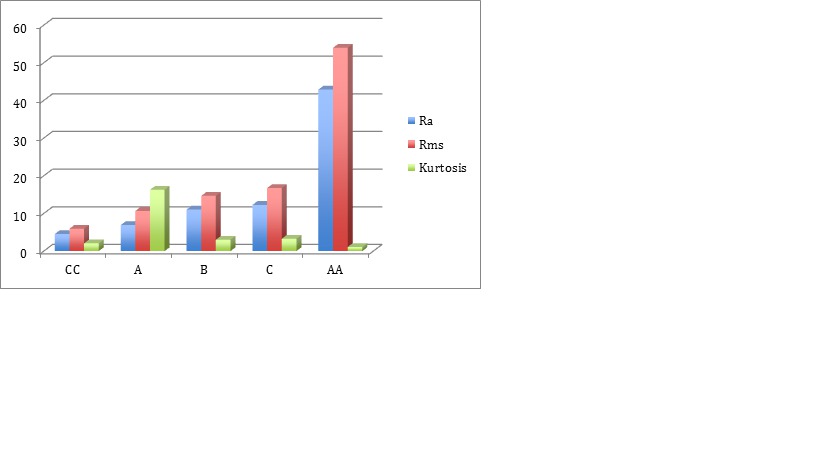
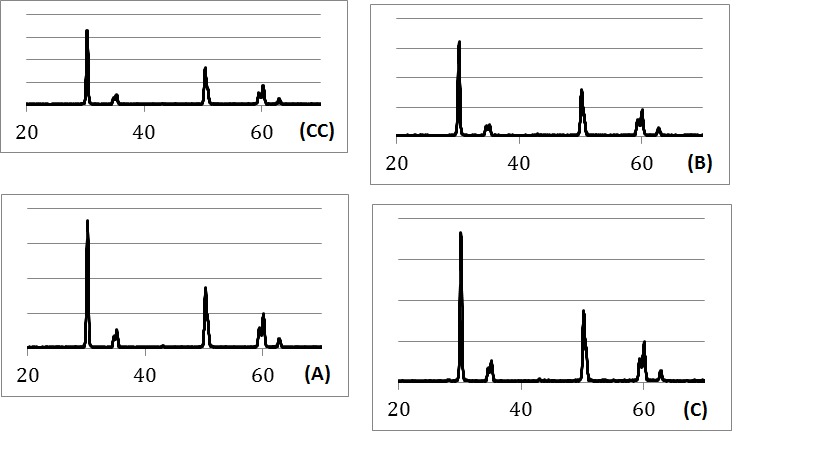
Methods: Five sintered blocks were divided according to surface treatment: CC: control group; A: 15min 10% hydrofluoric acid in low viscosity gel (HF) etching; B: 30min 10% HF etching; C: 60min 10% HF etching; AA: air abrasion with 50µm Al2O3 particles. The surfaces were then evaluated under atomic force microscopy (AFM) and X-ray diffraction (XRD). AFM measured changes in micro and nano-scale in surface topography. Five runs were made in each specimen, and the mean was taken (table.1 and image.1). The roughness (Ra and Rms) increased with increasing the time of exposing to HF. In XRD analysis monoclinic peak was not observed in groups CC, A, B, C (image.2).
Results: Despite the roughness obtained by acid etching is significantly lower than the sandblasting, based on techniques such as selective etching infiltrating (SIE), it’s believed that a low roughness can optimize adhesion. It has as advantage being considered a soft mechanism, that doesn’t induce tetragonal to monoclinic transformation, keeping the high fracture toughness of the material.
Conclusions: Considering the limitations of the study, it was concluded that HF can etch Y-TZP, creating micro and nano-morphological changes, without inducing zirconia tetragonal-to-monoclinic phase transformation, under tested conditionings.
Methods: Five sintered blocks were divided according to surface treatment: CC: control group; A: 15min 10% hydrofluoric acid in low viscosity gel (HF) etching; B: 30min 10% HF etching; C: 60min 10% HF etching; AA: air abrasion with 50µm Al2O3 particles. The surfaces were then evaluated under atomic force microscopy (AFM) and X-ray diffraction (XRD). AFM measured changes in micro and nano-scale in surface topography. Five runs were made in each specimen, and the mean was taken (table.1 and image.1). The roughness (Ra and Rms) increased with increasing the time of exposing to HF. In XRD analysis monoclinic peak was not observed in groups CC, A, B, C (image.2).
Results: Despite the roughness obtained by acid etching is significantly lower than the sandblasting, based on techniques such as selective etching infiltrating (SIE), it’s believed that a low roughness can optimize adhesion. It has as advantage being considered a soft mechanism, that doesn’t induce tetragonal to monoclinic transformation, keeping the high fracture toughness of the material.
Conclusions: Considering the limitations of the study, it was concluded that HF can etch Y-TZP, creating micro and nano-morphological changes, without inducing zirconia tetragonal-to-monoclinic phase transformation, under tested conditionings.
IMAGES
2631425_File000001.jpg
2631425_File000000.jpg
2631425_File000001.jpg
2631425_File000000.jpg