IADR Abstract Archives
A New in vivo System for the Study of Biofilms on Titanium Chips
Objectives: Analysis of in vivo grown oral biofilms on experimental titanium surfaces by fluorescence in situ hybridization (FISH)
Methods: This was a prospective comparative double-blind, controlled clinical study in 3 out of 48 patients (46 - 67 years), non-smokers, with advanced chronic periodontitis. All patients gave their written informed consent (approval by ehtical committee:132/12).
After initial periodontal examination, supragingival tooth cleaning and randomization on visit 2, blinded samples were inserted into the periodontal pockets and fixed by (Transbond, 3M ESPE). Carriers were kept in situ for 2, 4 , 7 , 14 days. Upon removal they were fixed, embedded and prepared for analysis by FISH to yield a qualitative microbiological analysis of the biofilm and to measure biofilm thickness by digital image analysis.
Four different titanium surfaces were tested in each patient [(machined, hydroxyapatite (thickness <1 μm), Plus® surface and an experimental surface (DENTSPLY)] in 4 palatal sites of 2 contralateral teeth. No periodontal and antimicrobial treatment was performed 6 months prior to and during the study also no oral disinfectants were used.
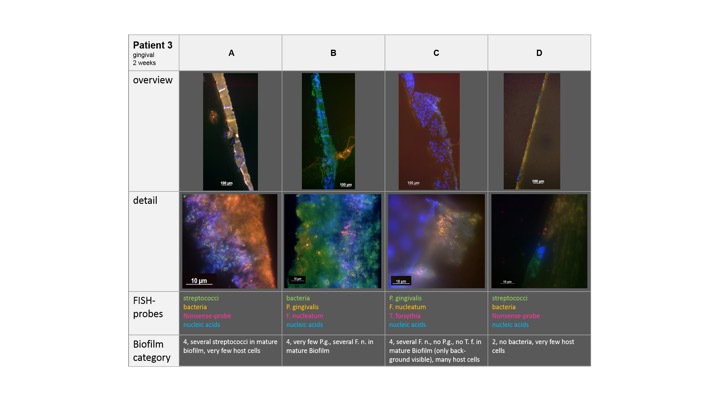
Results: Impressive qualitative and quantitative differences between the different surface types and time points were observed (p<0.05) (Fig. 1). A significant growth of biofilm thickness was detected over time (day 1: 10 µm - > 50 µm, day 14).
Although all investigated species (Streptococcus spp., Fusobacterium nucleatum (F.n.), Tannerella forsythia (T.f.) and Porphyromonas gingivalis (P.g.)) were detected to different extend in the biofilms, it seems that the majority of bacteria involved were not identified by these specific FISH probes. Streptococci did not impose as the early colonizers on the titanium surfaces. Interestingly, P. gingivalis, being one of the most abundant oral pathogens found in periodontitis, was rarely detected.
Conclusions: The results point to profound differences between periodontitis and peri-implantitis, which can now be further studied with the newly developed in vivo model.
Methods: This was a prospective comparative double-blind, controlled clinical study in 3 out of 48 patients (46 - 67 years), non-smokers, with advanced chronic periodontitis. All patients gave their written informed consent (approval by ehtical committee:132/12).
After initial periodontal examination, supragingival tooth cleaning and randomization on visit 2, blinded samples were inserted into the periodontal pockets and fixed by (Transbond, 3M ESPE). Carriers were kept in situ for 2, 4 , 7 , 14 days. Upon removal they were fixed, embedded and prepared for analysis by FISH to yield a qualitative microbiological analysis of the biofilm and to measure biofilm thickness by digital image analysis.
Four different titanium surfaces were tested in each patient [(machined, hydroxyapatite (thickness <1 μm), Plus® surface and an experimental surface (DENTSPLY)] in 4 palatal sites of 2 contralateral teeth. No periodontal and antimicrobial treatment was performed 6 months prior to and during the study also no oral disinfectants were used.
Results: Impressive qualitative and quantitative differences between the different surface types and time points were observed (p<0.05) (Fig. 1). A significant growth of biofilm thickness was detected over time (day 1: 10 µm - > 50 µm, day 14).
Although all investigated species (Streptococcus spp., Fusobacterium nucleatum (F.n.), Tannerella forsythia (T.f.) and Porphyromonas gingivalis (P.g.)) were detected to different extend in the biofilms, it seems that the majority of bacteria involved were not identified by these specific FISH probes. Streptococci did not impose as the early colonizers on the titanium surfaces. Interestingly, P. gingivalis, being one of the most abundant oral pathogens found in periodontitis, was rarely detected.
Conclusions: The results point to profound differences between periodontitis and peri-implantitis, which can now be further studied with the newly developed in vivo model.
IMAGES
2630982_File000000.jpg
2630982_File000000.jpg