IADR Abstract Archives
Apatite-zinc Coatings on Titanium Surface for Dental Implants Application
Objectives: The aim of this study was to deposit a coating of ZnHA on titanium surfaces by a biomimetic process and investigate the cytocompatibility of the new surface.
Methods: The biomimetic coating method is produced by using a solution containing high concentrations of calcium and phosphate with the addition of zinc. Activation of titanium surface was performed by oxidation with acidic solution (HF/HNO3), after 24 hours of immersion a thin layer of parascholzite is precipitated on Titanium. The coated substrates were then converted into HA by immersion in an alkali 0.1M NaOH solution. The coating was characterized by XRD, SEM/EDS, XRF, Profilometry. The viability and cell adhesion were assessed by direct contact using osteoblast culture.
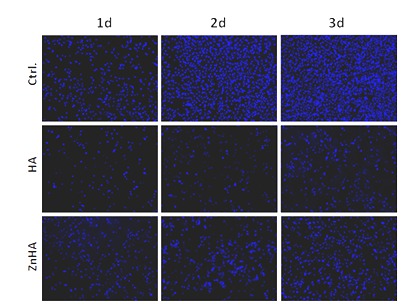
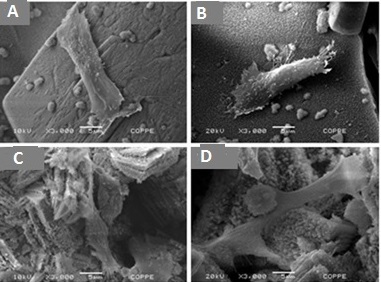
Results: The micrographs (SEM) show that, with the incorporation of zinc in the HA, there was a change in the morphology and size of the crystals. The XRD revealed HA as a single phase, what shows the incorporation of Zn in the HA without changing its structure. The percentage of Zinc coating was at 3% as measured by XRF and EDS. This study evaluated and compared the in vitro response of a cell line of human osteoblasts (HOB) over HA and ZnHA coatings. Both materials proved not to be toxic, confirming the biocompatibility and their ability to induce cellular proliferation (Fig. 1). In the quantitative analysis there was a significantly higher number of cells adhering to the coatings of ZnHA compared with coatings of HA . A positive effect of ions Zn on cell response was observed in doped with Zn coating the cells spread and grew favorably (Fig. 2), the proliferation was enhanced making this process faster compared whit HA coating. It can be also positively influenced for the size and morphology of this coating.
Conclusions: This study shows that the incorporation of 3% Zn in the structure of HA produces a change in morphology and size of crystals, showing that zinc is an inhibitor of the growth of apatite crystals. The composites tested did not alter cell viability and did not cause changes in cell morphology. The incorporation of Zn has positive effects on osteoblasts at low concentrations stimulating their adhetion and proliferation. In view of this reasons the ZnHA coating on titanium implants would have a potencial benefit to improve oseointegration process.
Methods: The biomimetic coating method is produced by using a solution containing high concentrations of calcium and phosphate with the addition of zinc. Activation of titanium surface was performed by oxidation with acidic solution (HF/HNO3), after 24 hours of immersion a thin layer of parascholzite is precipitated on Titanium. The coated substrates were then converted into HA by immersion in an alkali 0.1M NaOH solution. The coating was characterized by XRD, SEM/EDS, XRF, Profilometry. The viability and cell adhesion were assessed by direct contact using osteoblast culture.
Results: The micrographs (SEM) show that, with the incorporation of zinc in the HA, there was a change in the morphology and size of the crystals. The XRD revealed HA as a single phase, what shows the incorporation of Zn in the HA without changing its structure. The percentage of Zinc coating was at 3% as measured by XRF and EDS. This study evaluated and compared the in vitro response of a cell line of human osteoblasts (HOB) over HA and ZnHA coatings. Both materials proved not to be toxic, confirming the biocompatibility and their ability to induce cellular proliferation (Fig. 1). In the quantitative analysis there was a significantly higher number of cells adhering to the coatings of ZnHA compared with coatings of HA . A positive effect of ions Zn on cell response was observed in doped with Zn coating the cells spread and grew favorably (Fig. 2), the proliferation was enhanced making this process faster compared whit HA coating. It can be also positively influenced for the size and morphology of this coating.
Conclusions: This study shows that the incorporation of 3% Zn in the structure of HA produces a change in morphology and size of crystals, showing that zinc is an inhibitor of the growth of apatite crystals. The composites tested did not alter cell viability and did not cause changes in cell morphology. The incorporation of Zn has positive effects on osteoblasts at low concentrations stimulating their adhetion and proliferation. In view of this reasons the ZnHA coating on titanium implants would have a potencial benefit to improve oseointegration process.
IMAGES
2629048_File000001.jpg
2629048_File000000.jpg
2629048_File000001.jpg
2629048_File000000.jpg