IADR Abstract Archives
Long-term Effects of Different Cleaning Methods on Vivera® Retainers
Objectives: Clear retainers have increased in popularity due to their esthetic nature. However, few studies have focused on long-term maintenance of these retainers. This study evaluated the long-term effects of 7 different cleaning-methods on translucency, flexibility, and surface roughness of Vivera® material.
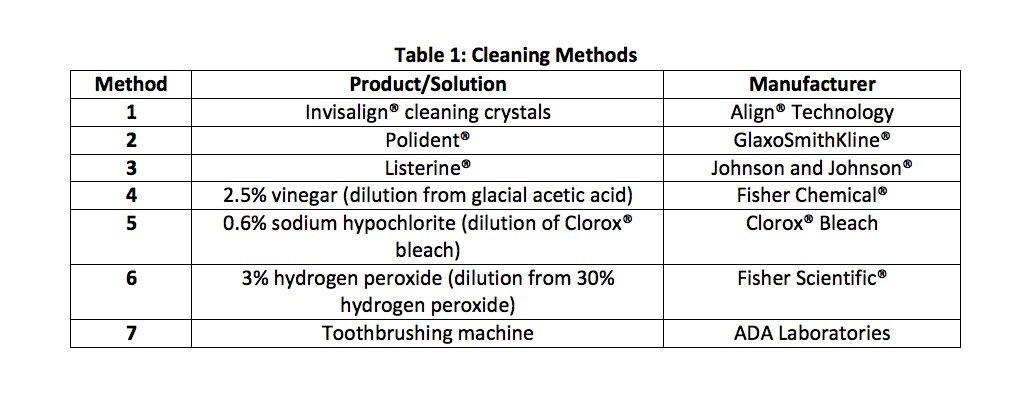
Methods: Vivera®-retainer (AlignTechnology) specimens (n=10,2x0.5x0.04in) were exposed to 7 different cleaning-methods(Table1) twice a week for 6months. As a negative control, specimens were brushed for 2minutes twice a week with a standardized toothbrushing machine. The specimens were in artificial saliva at 37°C when not exposed to the cleaning-methods. At 0,1,3, and 6months, translucency (% transmittance of light through specimen using spectrometer/integrating-sphere), flexibility (flexural modulus measured using 3-point-bend with Instron), and surface roughness (Surtronic3+ profilometer) of specimens were quantified. Qualitative assessment of random-specimens from each solution and control was performed at 6months using a scanning-electron-microscope (SEM). Mean comparisons were done using the independent Student t-test (P<0.05).
Results: A decrease in translucency of specimens was found with all cleaning-methods compared to baseline. Translucency comparable to brushing was found with vinegar after 1month and H2O2 at 3months. All other solutions exhibited significantly greater translucency values on specimens compared to brushing at every time-point. Listerine®, vinegar, and brushing increased specimen roughness while NaOCl decreased specimen roughness at 1month compared to baseline. Furthermore, NaOCl-specimens showed decreased roughness compared to brushing-specimens after 1month. Specimens became less flexible with Listerine®, vinegar, H2O2, and brushing compared to baseline. Cleaning-crystals and vinegar-specimens decreased in flexibility compared to brushing-specimens at 1month. For SEM analysis, no obvious qualitative differences were observed between specimens exposed to the various cleaning-methods and brushing-specimens.
Conclusions: The translucency of specimens decreased as early as 1-month after exposure to various cleaning-methods. Vinegar, H2O2, and brushing deteriorated the translucency of specimens more than the other cleaning-methods over time.
Methods: Vivera®-retainer (AlignTechnology) specimens (n=10,2x0.5x0.04in) were exposed to 7 different cleaning-methods(Table1) twice a week for 6months. As a negative control, specimens were brushed for 2minutes twice a week with a standardized toothbrushing machine. The specimens were in artificial saliva at 37°C when not exposed to the cleaning-methods. At 0,1,3, and 6months, translucency (% transmittance of light through specimen using spectrometer/integrating-sphere), flexibility (flexural modulus measured using 3-point-bend with Instron), and surface roughness (Surtronic3+ profilometer) of specimens were quantified. Qualitative assessment of random-specimens from each solution and control was performed at 6months using a scanning-electron-microscope (SEM). Mean comparisons were done using the independent Student t-test (P<0.05).
Results: A decrease in translucency of specimens was found with all cleaning-methods compared to baseline. Translucency comparable to brushing was found with vinegar after 1month and H2O2 at 3months. All other solutions exhibited significantly greater translucency values on specimens compared to brushing at every time-point. Listerine®, vinegar, and brushing increased specimen roughness while NaOCl decreased specimen roughness at 1month compared to baseline. Furthermore, NaOCl-specimens showed decreased roughness compared to brushing-specimens after 1month. Specimens became less flexible with Listerine®, vinegar, H2O2, and brushing compared to baseline. Cleaning-crystals and vinegar-specimens decreased in flexibility compared to brushing-specimens at 1month. For SEM analysis, no obvious qualitative differences were observed between specimens exposed to the various cleaning-methods and brushing-specimens.
Conclusions: The translucency of specimens decreased as early as 1-month after exposure to various cleaning-methods. Vinegar, H2O2, and brushing deteriorated the translucency of specimens more than the other cleaning-methods over time.
IMAGES
2628452_File000003.jpg
2628452_File000003.jpg