IADR Abstract Archives
Surface Modification Using ZrO2 Thin Film on Stainless Steel
Objectives: Stainless steels (SS) have been successfully used in orthopedics and dentistry for almost a full century. The mechanical properties and corrosion resistance of SS are good, and the cold work for stainless steel is easy. However, the use of SS is limited due to its poor optical properties and biocompatibility. Somwhow, the Ni and Cr from the corrosion product are carcinogenic.
For producing a homogenious thin layer of ZrO2 to provide better environment for osteoblastic cells, atomic layer deposition (ALD) technique is used. In this research, we tested different thickness(control and 5, 20, and 100 nm)of ZrO2 coating using ALD technique. The hypothesis is that thicker ZrO2 layer as expected to be more biocompatible. Scanning electron microscope were carried out in material analyses. Cell viability and F-actin stain were carried out in cell experiments.
Methods: We used ALD technique to coat ZrO2 on 316L SS surface with thicknesses of control, 5, 20, and 100 nm. The surface tompgrapgy was observed with AFM, and the surface roughness of different treatment was also measured. The cells used in evaluation of biocompatibility were HEPM. The MTT assay was used for cell vitability, and F-actin fluorescence staining was also utilized fluorescence microscope. The change of color in market orthodontic brackets coated 00 nm ZrO2 with ALD was also detected.
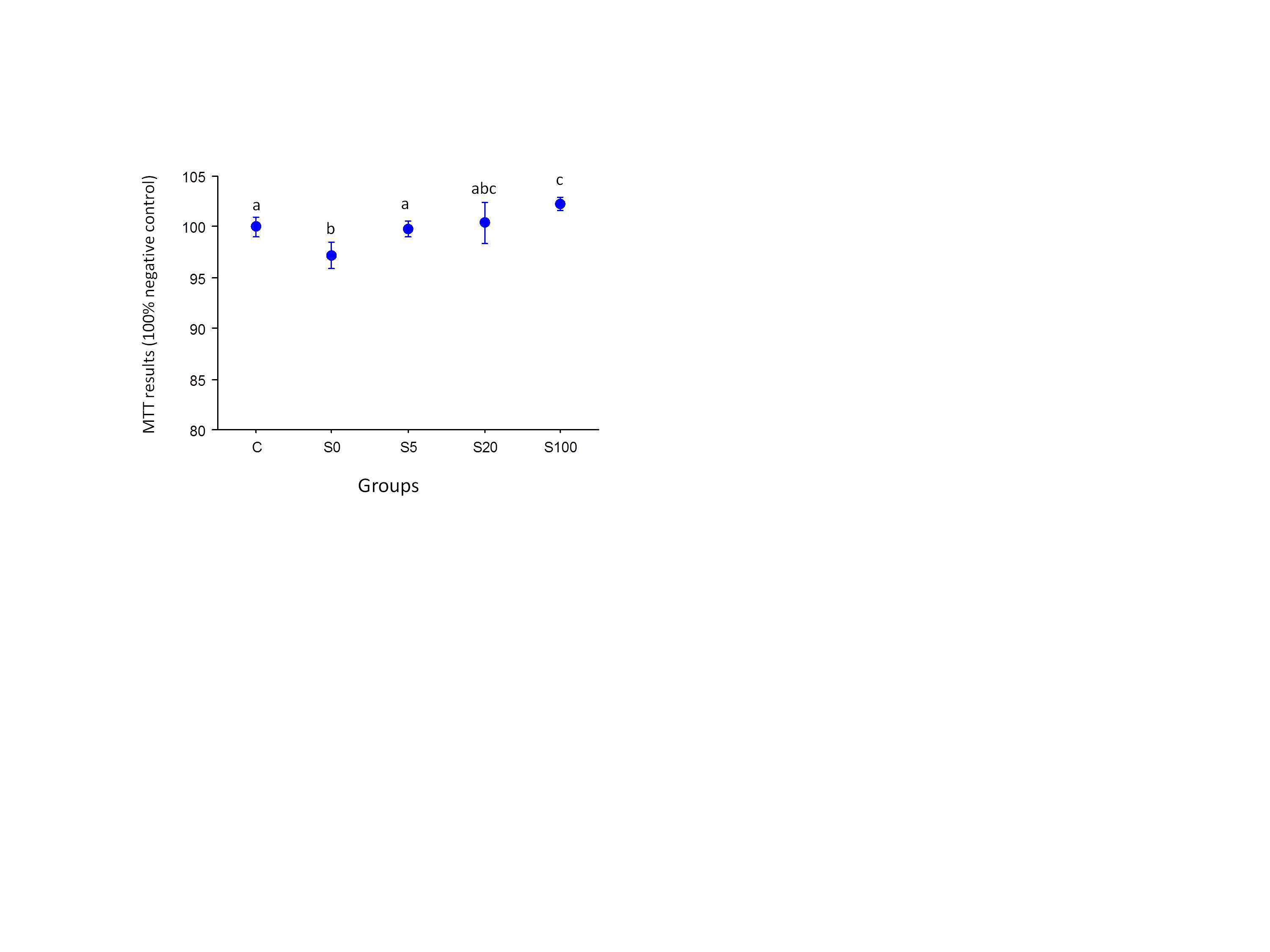
Results: When the thickness of coating layer was increased, the surface roughness was also increased. There was positive relation between coating thickness and surface roughness. When the coating thickness was increased, the ZrO2 crystal on SS surface was more prominent. The color changes of SS bracket from dark grey become golden or golend-blue. The cytotoxicity of uncoated SS was significant higher than control and other groups. The biocompatibility of SS 100 was best among these groups.
Conclusions: The results of SS coated ZrO2 with ALD were: (1) the color was changed; (2) the surface roughness was increased as the layer of ZrO2 increased; (3) the biocompatibility was improved. The hypothesis was accepted.
For producing a homogenious thin layer of ZrO2 to provide better environment for osteoblastic cells, atomic layer deposition (ALD) technique is used. In this research, we tested different thickness(control and 5, 20, and 100 nm)of ZrO2 coating using ALD technique. The hypothesis is that thicker ZrO2 layer as expected to be more biocompatible. Scanning electron microscope were carried out in material analyses. Cell viability and F-actin stain were carried out in cell experiments.
Methods: We used ALD technique to coat ZrO2 on 316L SS surface with thicknesses of control, 5, 20, and 100 nm. The surface tompgrapgy was observed with AFM, and the surface roughness of different treatment was also measured. The cells used in evaluation of biocompatibility were HEPM. The MTT assay was used for cell vitability, and F-actin fluorescence staining was also utilized fluorescence microscope. The change of color in market orthodontic brackets coated 00 nm ZrO2 with ALD was also detected.
Results: When the thickness of coating layer was increased, the surface roughness was also increased. There was positive relation between coating thickness and surface roughness. When the coating thickness was increased, the ZrO2 crystal on SS surface was more prominent. The color changes of SS bracket from dark grey become golden or golend-blue. The cytotoxicity of uncoated SS was significant higher than control and other groups. The biocompatibility of SS 100 was best among these groups.
Conclusions: The results of SS coated ZrO2 with ALD were: (1) the color was changed; (2) the surface roughness was increased as the layer of ZrO2 increased; (3) the biocompatibility was improved. The hypothesis was accepted.
IMAGES
2627048_File000000.jpg
2627048_File000000.jpg