IADR Abstract Archives
Antinociceptive Effect of Resolvin D1 on Bone Cancer Pain
Objectives: Resolvin D1 (RvD1) is an endogenous lipid mediator synthetized from w-3-polyunsaturated fatty acid. RvD1 acts on the peripheral and central nervous system inducing antinociception. In this project we explored systemic and intrathecal (i.t.) anti-hyperalgesic effects of RvD1 during bone cancer pain and the involvement of prostaglandin signaling in this effect.
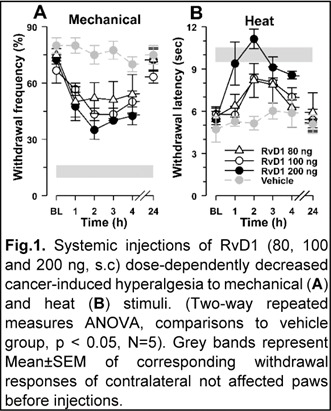
Methods: Fibrosarcoma cells were injected in the calcaneus bone of mice to induce tumor development and mechanical and heat hyperalgesia. RvD1 was administered subcutaneously (s.c.) (80, 100, and 200ng / 50µl) or i.t (0.0001 - 3 ng / 5µl). Mechanical and heat hyperalgesia were determined by measuring the frequency of withdrawal evoked by a 3.9 mN von Frey monofilament and the withdrawal latency to radiant heat delivered to the plantar surface of the paw 1,2,3,4 and 24 hours following injections. Activity of cyclooxygenase-2 (COX-2) in the spinal cord and dorsal root ganglia (DRG) was evaluated calorimetrically.
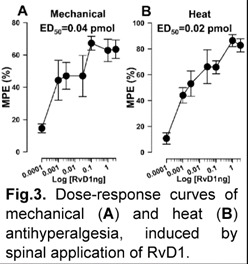
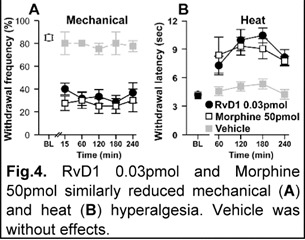
Results: Systemic and i.t. administration of RvD1 reduced mechanical and heat hyperalgesia. I.t. delivery reduced mechanical and heat hyperalgesia with similar potencies (ED50 values for pain inhibition were 0.04 pmol and 0.02 pmol, respectively). I.t. injection of RvD1 (0.03 pmol) and morphine (50 pmol) showed comparable anti-hyperalgesia suggesting that RvD1 is ~1700 times more potent than morphine. Administration of RvD1 reduced activity of COX-2 in the spinal cord and DRG, suggesting that RvD1 decreases pronociceptive effects of prostaglandins.
Conclusions: We demonstrated that RvD1 induces robust antinociception in a model of bone cancer pain following both systemic and i.t. administration. One underlying mechanism is the inhibition of enzymes that synthetize prostaglandins. These studies can potentially lead to a new and effective way of treating severe bone cancer pain.
Methods: Fibrosarcoma cells were injected in the calcaneus bone of mice to induce tumor development and mechanical and heat hyperalgesia. RvD1 was administered subcutaneously (s.c.) (80, 100, and 200ng / 50µl) or i.t (0.0001 - 3 ng / 5µl). Mechanical and heat hyperalgesia were determined by measuring the frequency of withdrawal evoked by a 3.9 mN von Frey monofilament and the withdrawal latency to radiant heat delivered to the plantar surface of the paw 1,2,3,4 and 24 hours following injections. Activity of cyclooxygenase-2 (COX-2) in the spinal cord and dorsal root ganglia (DRG) was evaluated calorimetrically.
Results: Systemic and i.t. administration of RvD1 reduced mechanical and heat hyperalgesia. I.t. delivery reduced mechanical and heat hyperalgesia with similar potencies (ED50 values for pain inhibition were 0.04 pmol and 0.02 pmol, respectively). I.t. injection of RvD1 (0.03 pmol) and morphine (50 pmol) showed comparable anti-hyperalgesia suggesting that RvD1 is ~1700 times more potent than morphine. Administration of RvD1 reduced activity of COX-2 in the spinal cord and DRG, suggesting that RvD1 decreases pronociceptive effects of prostaglandins.
Conclusions: We demonstrated that RvD1 induces robust antinociception in a model of bone cancer pain following both systemic and i.t. administration. One underlying mechanism is the inhibition of enzymes that synthetize prostaglandins. These studies can potentially lead to a new and effective way of treating severe bone cancer pain.
IMAGES
2626902_File000000.jpg
2626902_File000001.jpg
2626902_File000002.jpg
2626902_File000000.jpg
2626902_File000001.jpg
2626902_File000002.jpg