IADR Abstract Archives
Immobilized LAM and AMBN Increase Keratinocyte Adhesion on Ti Substrates
Objectives: Titanium (Ti) materials have been functionalized with biomolecules as a modern strategy to incorporate bioactive motifs to expand and improve their properties. Laminin 332 participates in the formation of hemidesmosomes and promotes epithelial adhesion around teeth and implants. Ameloblastin, an enamel matrix protein, is reportedly involved in the events following disruption of the junctional epithelium.
Our objective was to bio-functionalize Ti substrates with a Laminin 332 derived peptide (LAM), an Ameloblastin derived peptide (AMBN) or combinations of both peptides and assess epithelial adhesion on Ti substrates in each condition.
Methods: LAM, AMBN or combinations of both peptides were covalently immobilized on Ti discs. Successful immobilization of the peptides on Ti discs was confirmed by XPS (X-ray photoelectron spectroscopy), contact angle assay and fluorescent labeling. Additionally, mechanical and thermochemical tests assessing the stability of the peptides on Ti surfaces were performed. Immortalized oral keratinocytes (TERT-2/OKF-6) were cultured on LAM, AMBN or combinations of both peptides coated Ti substrates and hemidesmosome formation was investigated via immunofluorescence and western blotting up to 48 hours. Cell proliferation was also assessed. Statistical analysis with linear regression models was utilized and the level of significance was set at 0.05.
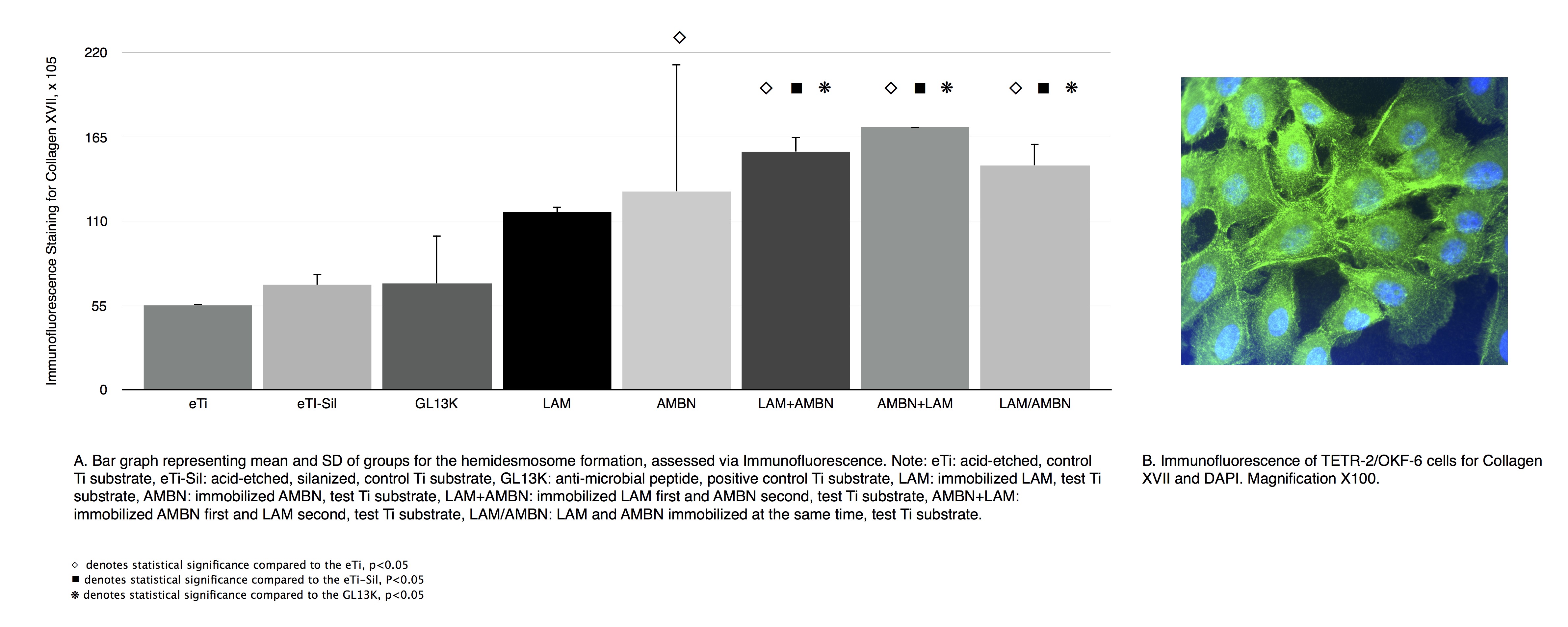
Results: High amounts of well-anchored and homogeneously distributed peptides were identified on the Ti surfaces. The immobilized peptides exhibited mechanical and thermochemical stability following in vitro simulated challenges. TERT-2/OKF-6 cell proliferation exhibited a trend to be increased in the LAM or AMBN coated discs at 48h of incubation. However, the combinations of both peptides, irrespective of the methodological sequence of immobilization, induced the highest hemidesmosome formation at 48h (p<0.05). (Figure)
Conclusions: The immobilization of combinations of LAM and AMBN derived peptides on Ti substrates promotes hemidesmosome formation at 48 hours. Thus, these peptide coatings are preferential candidates to establish a stable per-mucosal seal around dental implants.
Received funding from: Erwin Schaffer Chair in Periodontics, University of Minnesota and NIH-NIDCR #R01DE026117-01
Our objective was to bio-functionalize Ti substrates with a Laminin 332 derived peptide (LAM), an Ameloblastin derived peptide (AMBN) or combinations of both peptides and assess epithelial adhesion on Ti substrates in each condition.
Methods: LAM, AMBN or combinations of both peptides were covalently immobilized on Ti discs. Successful immobilization of the peptides on Ti discs was confirmed by XPS (X-ray photoelectron spectroscopy), contact angle assay and fluorescent labeling. Additionally, mechanical and thermochemical tests assessing the stability of the peptides on Ti surfaces were performed. Immortalized oral keratinocytes (TERT-2/OKF-6) were cultured on LAM, AMBN or combinations of both peptides coated Ti substrates and hemidesmosome formation was investigated via immunofluorescence and western blotting up to 48 hours. Cell proliferation was also assessed. Statistical analysis with linear regression models was utilized and the level of significance was set at 0.05.
Results: High amounts of well-anchored and homogeneously distributed peptides were identified on the Ti surfaces. The immobilized peptides exhibited mechanical and thermochemical stability following in vitro simulated challenges. TERT-2/OKF-6 cell proliferation exhibited a trend to be increased in the LAM or AMBN coated discs at 48h of incubation. However, the combinations of both peptides, irrespective of the methodological sequence of immobilization, induced the highest hemidesmosome formation at 48h (p<0.05). (Figure)
Conclusions: The immobilization of combinations of LAM and AMBN derived peptides on Ti substrates promotes hemidesmosome formation at 48 hours. Thus, these peptide coatings are preferential candidates to establish a stable per-mucosal seal around dental implants.
Received funding from: Erwin Schaffer Chair in Periodontics, University of Minnesota and NIH-NIDCR #R01DE026117-01
IMAGES
2622364_File000001.jpg
2622364_File000001.jpg