IADR Abstract Archives
Effect of Adhesive and Curing on Microleakage in Sealants
Objectives: To study the effect of adhesive and curing method on microleakage in sealants.
Methods: 72 noncarious extracted molars were randomly sorted into 9 groups (n=8). Clinpro (3M ESPE), Ultraseal XT Hydro (Ultradent), and Fluorshield VLC (Dentsply), were placed on etched fissures with or without adhesive (Adper Single Bond Plus, 3M ESPE). Each sealant with adhesive was also divided into two groups: light-cured (CB) and noncured (NC). Control (S) used no adhesive. The samples were thermocycled (5-55oC, 1000 cycles), coated with nail polish except for occlusal surface, and were immersed in 2% basic fuchsin for 24 hours. Each sample was sectioned into 1 mm-thick slices, and photographed under a microscope at 4x magnification. The microleakage was measured based on the visual estimation of dye penetration depth proportional to sealant depth (0:no penetration, 1:1/4, 2:1/2, 3:3/4, and 4:penetration to bottom of the fissure). The microleakage depth was also measured digitally and calculated. The data was analyzed using ANOVA, Tukey’s studentized ranged test, Pearson, and Kappa statistical tests.
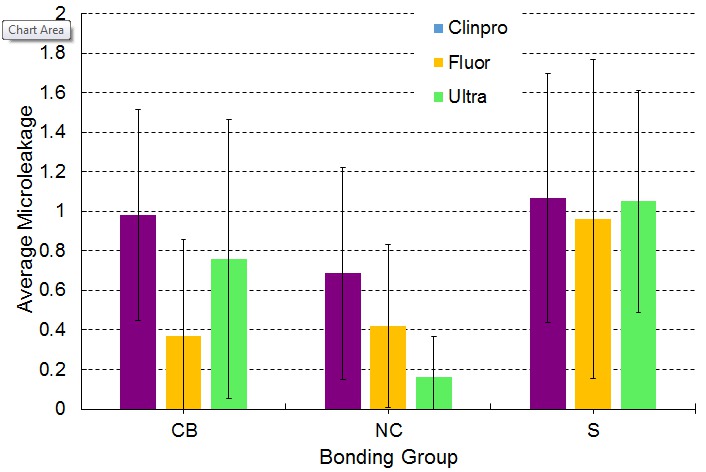
Results: The ANOVA test did not reveal a significant difference in microleakage among 3 sealants (p=0.1156). With all sealants, NC had the least microleakage. Tukey’s studentized ranged test found no significant difference with application type and Clinpro or Fluoroshield (0.3847 and 0.1119 respectively), but Ultraseal placed with NC exhibited significantly less microleakage than sealant without bonding agent (p=0.0103). When the 3 sealants were pooled together, the NC had significantly less microleakage than S. When microleakage depth was calculated, they were highly correlated (Pearson =0.99037) and Kappa statistics found good agreement (0.8105) with the visual estimation.
Conclusions: Use of uncured bonding agent beneath sealants results in significantly less microleakage than those without bonding agent, although this outcome varied by the sealant type. Direct digital measurement of microleakage may be a better alternative to the past microleakage protocols.
Methods: 72 noncarious extracted molars were randomly sorted into 9 groups (n=8). Clinpro (3M ESPE), Ultraseal XT Hydro (Ultradent), and Fluorshield VLC (Dentsply), were placed on etched fissures with or without adhesive (Adper Single Bond Plus, 3M ESPE). Each sealant with adhesive was also divided into two groups: light-cured (CB) and noncured (NC). Control (S) used no adhesive. The samples were thermocycled (5-55oC, 1000 cycles), coated with nail polish except for occlusal surface, and were immersed in 2% basic fuchsin for 24 hours. Each sample was sectioned into 1 mm-thick slices, and photographed under a microscope at 4x magnification. The microleakage was measured based on the visual estimation of dye penetration depth proportional to sealant depth (0:no penetration, 1:1/4, 2:1/2, 3:3/4, and 4:penetration to bottom of the fissure). The microleakage depth was also measured digitally and calculated. The data was analyzed using ANOVA, Tukey’s studentized ranged test, Pearson, and Kappa statistical tests.
Results: The ANOVA test did not reveal a significant difference in microleakage among 3 sealants (p=0.1156). With all sealants, NC had the least microleakage. Tukey’s studentized ranged test found no significant difference with application type and Clinpro or Fluoroshield (0.3847 and 0.1119 respectively), but Ultraseal placed with NC exhibited significantly less microleakage than sealant without bonding agent (p=0.0103). When the 3 sealants were pooled together, the NC had significantly less microleakage than S. When microleakage depth was calculated, they were highly correlated (Pearson =0.99037) and Kappa statistics found good agreement (0.8105) with the visual estimation.
Conclusions: Use of uncured bonding agent beneath sealants results in significantly less microleakage than those without bonding agent, although this outcome varied by the sealant type. Direct digital measurement of microleakage may be a better alternative to the past microleakage protocols.
IMAGES
2620879_File000002.jpg
2620879_File000002.jpg