IADR Abstract Archives
Implant Treatment Outcomes Were Not Associated With Sinus Mucosal Thickening
Objectives: The purpose of this retrospective study was to evaluate the outcomes of dental implant placement in sinus augmented areas with pre-existing mucosal thickening.
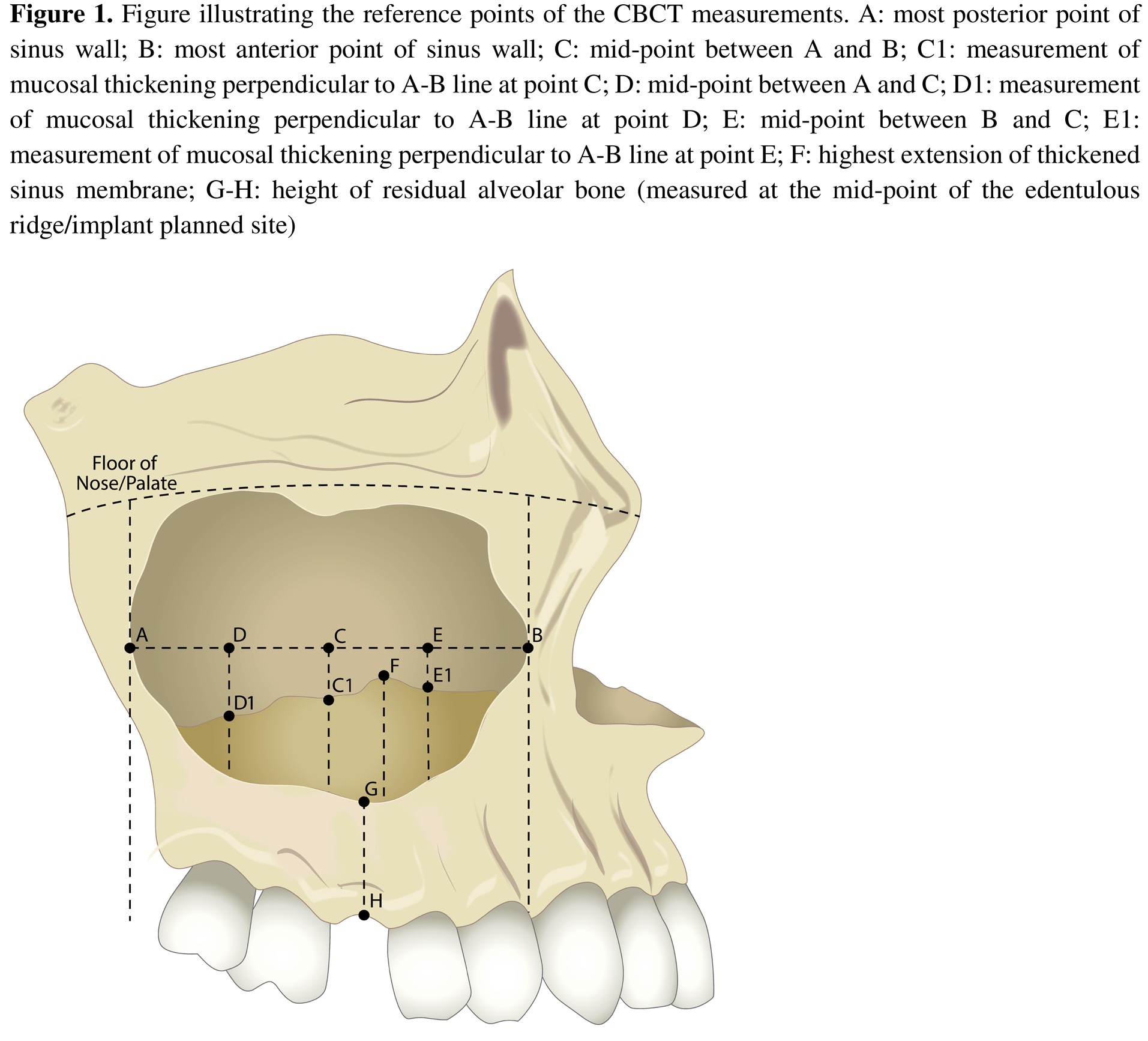
Methods: This study involved the review of cone-beam computed tomographic (CBCT) scans taken on patients who underwent both maxillary sinus elevation with grafting and implant placement at the University of Michigan School of Dentistry from 2004-2014. Cases with documented radiographic and clinical follow-up were included. Measurements of sinus mucosal thickening were performed (Figure 1). Association between mucosal thickening and parameters related to patients’ systemic conditions and clinical factors were analyzed using linear mixed models.
Results: A total of 29 CBCT scans were evaluated and 93.1% of them had maxillary sinus mucosal thickening. Specifically, 6.9% of cases exhibited no thickening, 6.9% of cases had minimal thickening (1-2mm), 20.7% had moderate thickening (2-5mm), and 65.5% had severe thickening (>5mm). We propose these categorical measurements of tissue thickening as a new “mucosal thickening index." Only 45.9% of implant sites presented sinus mucosal thickening. Furthermore, the largest tissue thickening was present in the middle section of the maxillary sinus. Tissue thickening did not vary based on gender, age or smoking status, nor did it relate to underlying alveolar ridge height. However, patients with a history of periodontal diseases demonstrated a significant association with mucosal thickening (p= 0.0043, Table 1). The data indicate that there is high implant and grafting success rate (100%) in the maxillary sinus despite large and varied physiologic sinus mucosal/tissue thickening.
Conclusions: These findings will help guide dental practitioners regarding cases that exhibit mucosal thickening. Patients with a history of periodontal diseases demonstrated a significant association with mucosal thickening. However, the current study supports the concept that physiologic mucosal thickening in varied ranges is not associated with implant or grafting failure in the maxillary sinus.
Methods: This study involved the review of cone-beam computed tomographic (CBCT) scans taken on patients who underwent both maxillary sinus elevation with grafting and implant placement at the University of Michigan School of Dentistry from 2004-2014. Cases with documented radiographic and clinical follow-up were included. Measurements of sinus mucosal thickening were performed (Figure 1). Association between mucosal thickening and parameters related to patients’ systemic conditions and clinical factors were analyzed using linear mixed models.
Results: A total of 29 CBCT scans were evaluated and 93.1% of them had maxillary sinus mucosal thickening. Specifically, 6.9% of cases exhibited no thickening, 6.9% of cases had minimal thickening (1-2mm), 20.7% had moderate thickening (2-5mm), and 65.5% had severe thickening (>5mm). We propose these categorical measurements of tissue thickening as a new “mucosal thickening index." Only 45.9% of implant sites presented sinus mucosal thickening. Furthermore, the largest tissue thickening was present in the middle section of the maxillary sinus. Tissue thickening did not vary based on gender, age or smoking status, nor did it relate to underlying alveolar ridge height. However, patients with a history of periodontal diseases demonstrated a significant association with mucosal thickening (p= 0.0043, Table 1). The data indicate that there is high implant and grafting success rate (100%) in the maxillary sinus despite large and varied physiologic sinus mucosal/tissue thickening.
Conclusions: These findings will help guide dental practitioners regarding cases that exhibit mucosal thickening. Patients with a history of periodontal diseases demonstrated a significant association with mucosal thickening. However, the current study supports the concept that physiologic mucosal thickening in varied ranges is not associated with implant or grafting failure in the maxillary sinus.
IMAGES
2616556_File000000.jpg
2616556_File000000.jpg