IADR Abstract Archives
Bonding to CAD/CAM Composites: Influence of Airabrasion and Conditioning Method
Objectives: The objective of this study was to investigate the tensile bond strength between four different CAD/CAM composites and one resin composite cement with and without air abrasion and using either silane or a bonding adhesive.
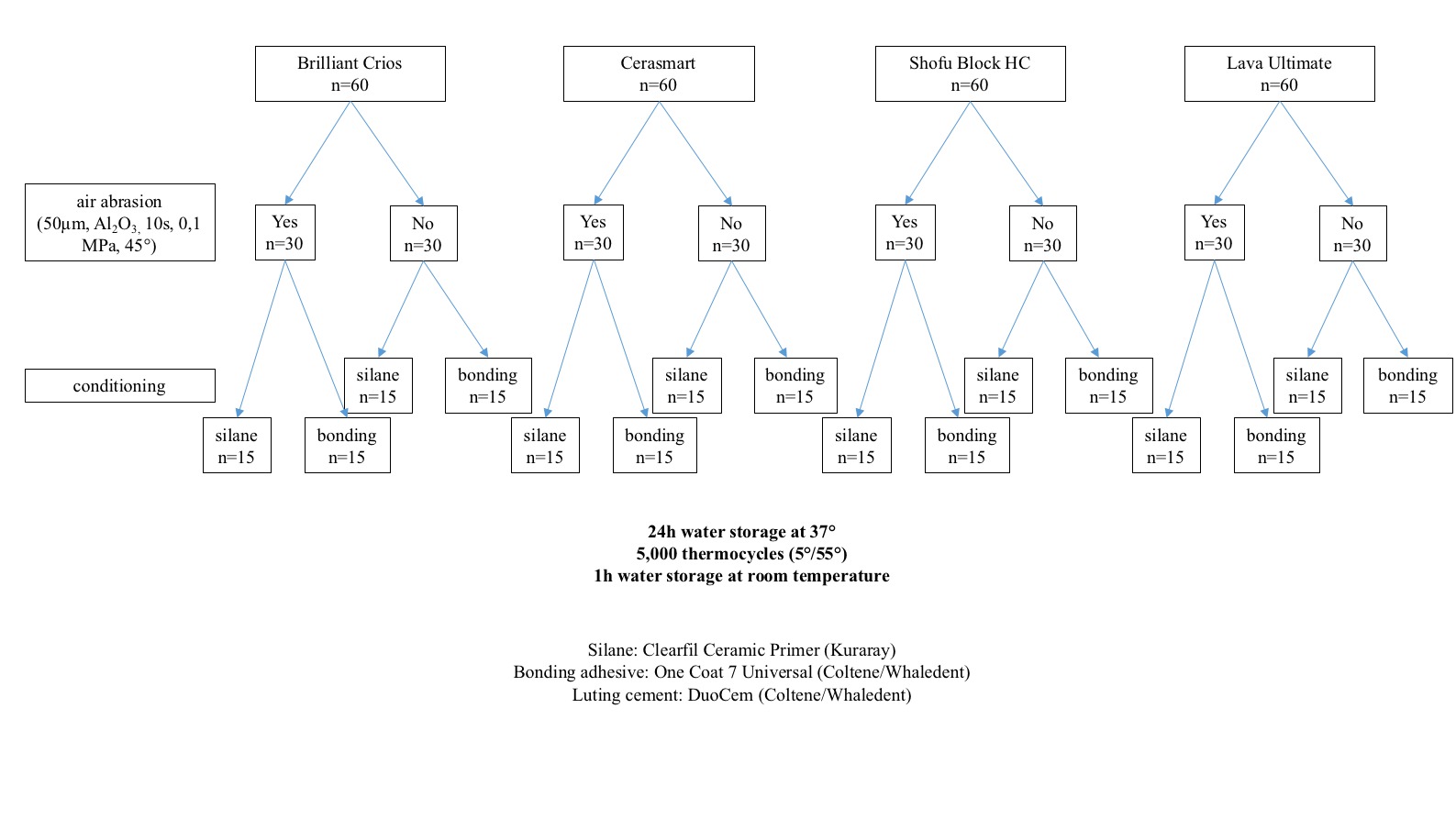
Methods: Four different CAD/CAM composites were tested: i. Brilliant Crios (Coltene), ii. Cerasmart (GC Europe), iii. Shofu Block HC (Shofu) and iv. Lava Ultimate (3M) and a resin composite cement (DuoCem, Coltene). Of each CAD/CAM material 60 specimens were prepared (N=240) and divided into two groups (n=30). One group was air abraded for 10 seconds (Al2O3, 50 µm, pressure 0.1 MP). Each CAD/CAM group was further divided into 2 subgroups (n=15) and conditioned with either silane (Clearfil Ceramic Primer, Kuraray) or bonding adhesive (One Coat 7 Universal, Coltene/Whaledent). After the conditioning, a PMMA-cylinder was placed on the conditioned surface and filled with resin composite cement (DuoCem, Coltene). After light polymerization a thermocycling process (5,000 cycles between 5°C and 55°C) was performed. For tensile bond strength measurements, an universal machine was used (Zwick 1445). The data was analyzed using Kolmogorov-Smirnov test, general linear model analysis, Chi2-test, Kaplan–Meier survival estimates, and Breslow–Gehan tests (p<0.05).
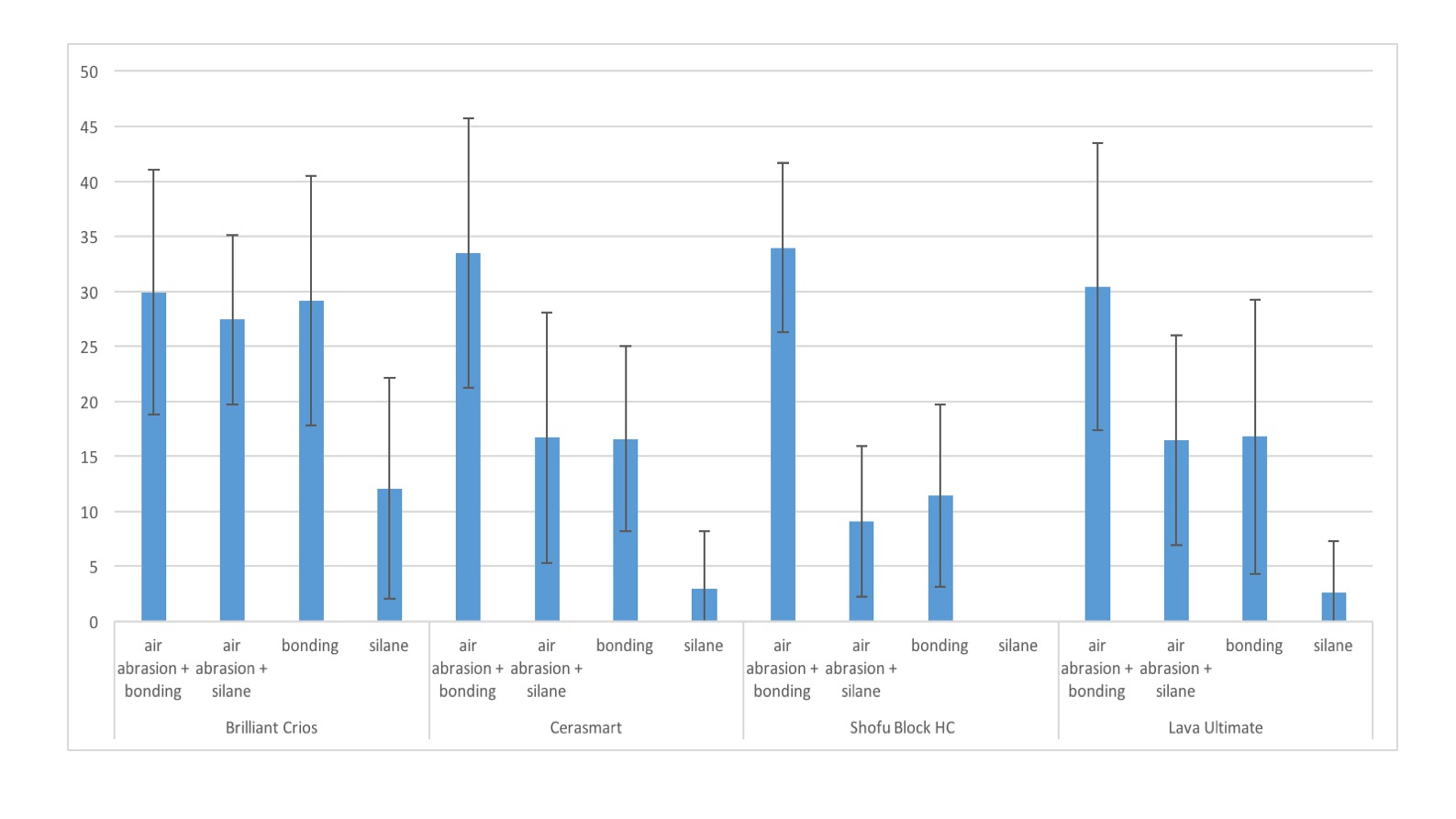
Results: The highest influence on the bond strength was exerted by the use of bonding adhesive (partial eta squared ηP2 = 0.383, p<0.001) followed by the air abrasion (ηP2 = 0.355, p<0.001), and the use of the CAD/CAM composite (ηP2 = 0.178, p<0.001). The additional air abrasion step increased the tensile bond strength values. Specimens conditioned using a bonding adhesive showed higher bond strength than these conditioned using silane.
Conclusions: Airabrasion and the use of a bonding adhesive seems to be the best pretreatment strategy to create a reliable bond between the CAD/CAM composite and resin cement. In general, it can be stated, that the measurements in combination with the CAD/CAM block Brilliant Crios showed higher tensile bond strength values compared to the remaining CAD/CAM blocks. This may lead to the assumption that there are more free carbon-carbon-double binds on the surface of Brilliant Crios than on the other materials. More clinical research is mandatory to further investigate the performance of CAD/CAM resin composites.
Methods: Four different CAD/CAM composites were tested: i. Brilliant Crios (Coltene), ii. Cerasmart (GC Europe), iii. Shofu Block HC (Shofu) and iv. Lava Ultimate (3M) and a resin composite cement (DuoCem, Coltene). Of each CAD/CAM material 60 specimens were prepared (N=240) and divided into two groups (n=30). One group was air abraded for 10 seconds (Al2O3, 50 µm, pressure 0.1 MP). Each CAD/CAM group was further divided into 2 subgroups (n=15) and conditioned with either silane (Clearfil Ceramic Primer, Kuraray) or bonding adhesive (One Coat 7 Universal, Coltene/Whaledent). After the conditioning, a PMMA-cylinder was placed on the conditioned surface and filled with resin composite cement (DuoCem, Coltene). After light polymerization a thermocycling process (5,000 cycles between 5°C and 55°C) was performed. For tensile bond strength measurements, an universal machine was used (Zwick 1445). The data was analyzed using Kolmogorov-Smirnov test, general linear model analysis, Chi2-test, Kaplan–Meier survival estimates, and Breslow–Gehan tests (p<0.05).
Results: The highest influence on the bond strength was exerted by the use of bonding adhesive (partial eta squared ηP2 = 0.383, p<0.001) followed by the air abrasion (ηP2 = 0.355, p<0.001), and the use of the CAD/CAM composite (ηP2 = 0.178, p<0.001). The additional air abrasion step increased the tensile bond strength values. Specimens conditioned using a bonding adhesive showed higher bond strength than these conditioned using silane.
Conclusions: Airabrasion and the use of a bonding adhesive seems to be the best pretreatment strategy to create a reliable bond between the CAD/CAM composite and resin cement. In general, it can be stated, that the measurements in combination with the CAD/CAM block Brilliant Crios showed higher tensile bond strength values compared to the remaining CAD/CAM blocks. This may lead to the assumption that there are more free carbon-carbon-double binds on the surface of Brilliant Crios than on the other materials. More clinical research is mandatory to further investigate the performance of CAD/CAM resin composites.
IMAGES
2590132_File000000.jpg
2590132_File000001.jpg
2590132_File000000.jpg
2590132_File000001.jpg