IADR Abstract Archives
Carbamide Peroxide Effect on Some Properties of Composite Resins
Objectives: The aim of this study was to evaluate the effect of bleaching gel containing different concentrations of Carbamide Peroxide on tow composite material according two points of view:
Surface morphology of composite restoration by using scanning electron microscope (SEM).
Microleakage of class V cavities restored with mentioned Composite
Methods: The following material was used:
Composite : Tetric Ceram and Charisma
Bleaching Gel: Opalescence 10-15-20%
Two samples were prepared:
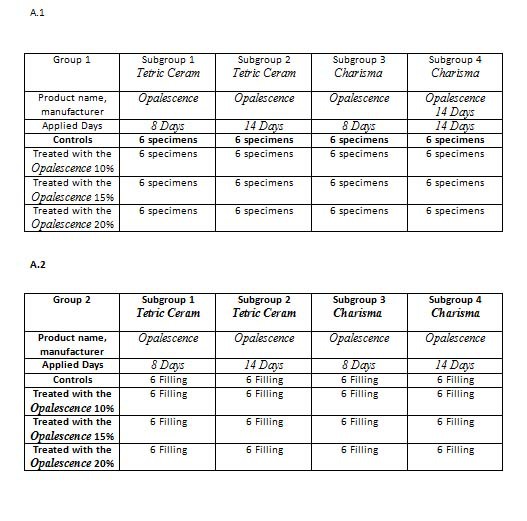
Group1: included 96 tablets of 6mm in diameter, 3mm in thickness divided into four subgroups each containing 24 specimens of mentioned restorative material according to the concentration of bleaching agent and period of a administration. Photo1 (A.1)
Group2: including 96 freshly extracted human premolars. GlassV standardized cavities 2X4 mm were prepared on facial surfaces divided into the mentioned restorative materials according to the concentration and period of administration of the bleaching gel.Photo1(A.2)
The two groups treated with the bleaching agent 8 hours for 8 &14 days. Six specimens of tablets and six of premolars were used as controls for each restorative material.
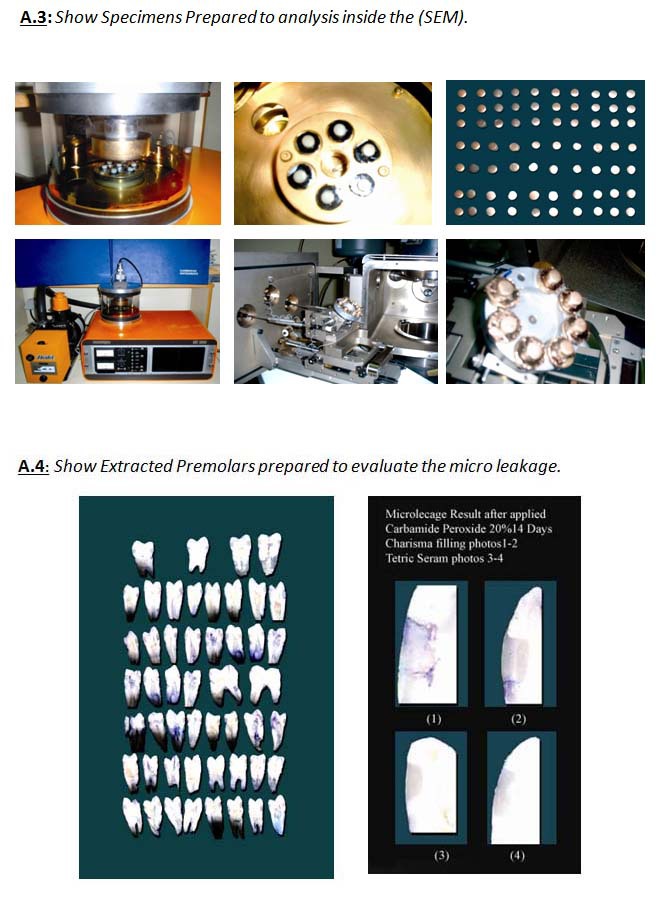
The tablets were analyzed by SEM, Photos 2 (A.3)
Premolars were studied after thermo cycling, immersion in 0.5% tuliden blue solution for 24 hours, and sectioning longitudinally in faciolingual direction, by stereomicroscope. Photos 2 (A.4)
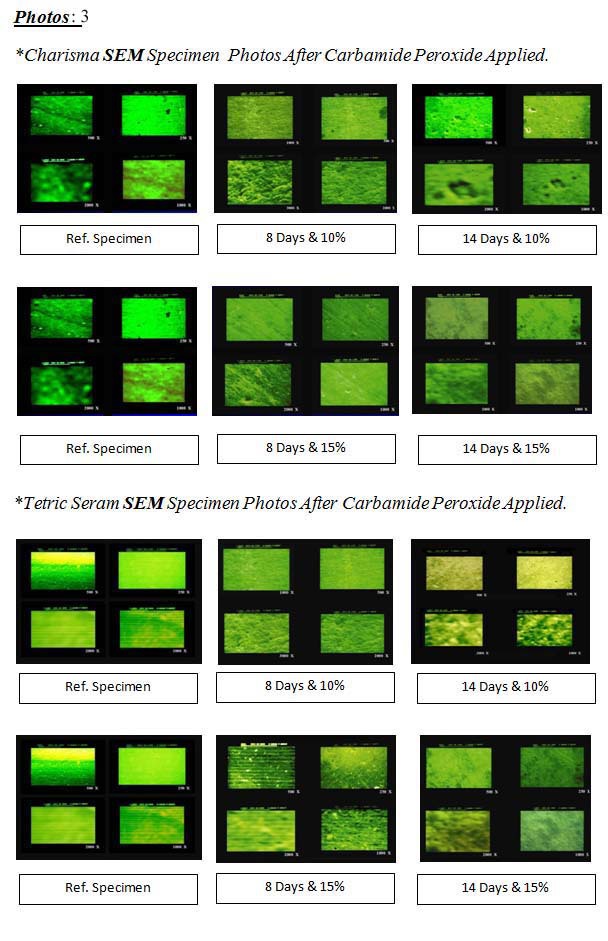
Results: The SME analysis revealed differences between the surface morphology of specimens treated with bleaching gels and control specimens. And its more detectable when the concentrations of bleaching gel and period of applying is increased.
Where an obvious degradation in matrix was noticed, and the glass particles were exposed increasing surface roughness, where the matrix surrounded fully the filler particles of the control Photos 3
Statistical analysis using T student test (P=0.05) of the specimens studied to measure the degree of
Microleakage showed.
Significant differences were noticed between control specimens and treated specimens.
Degree of microleakage increases when concentration increases.
No significant differences were noticed between 14 dyes group & 8 days group.
Conclusions: This study show, treatment of composites with bleaching agents containing carbmide peroxide leads to increase in surface roughness and microleakage.
Surface morphology of composite restoration by using scanning electron microscope (SEM).
Microleakage of class V cavities restored with mentioned Composite
Methods: The following material was used:
Composite : Tetric Ceram and Charisma
Bleaching Gel: Opalescence 10-15-20%
Two samples were prepared:
Group1: included 96 tablets of 6mm in diameter, 3mm in thickness divided into four subgroups each containing 24 specimens of mentioned restorative material according to the concentration of bleaching agent and period of a administration. Photo1 (A.1)
Group2: including 96 freshly extracted human premolars. GlassV standardized cavities 2X4 mm were prepared on facial surfaces divided into the mentioned restorative materials according to the concentration and period of administration of the bleaching gel.Photo1(A.2)
The two groups treated with the bleaching agent 8 hours for 8 &14 days. Six specimens of tablets and six of premolars were used as controls for each restorative material.
The tablets were analyzed by SEM, Photos 2 (A.3)
Premolars were studied after thermo cycling, immersion in 0.5% tuliden blue solution for 24 hours, and sectioning longitudinally in faciolingual direction, by stereomicroscope. Photos 2 (A.4)
Results: The SME analysis revealed differences between the surface morphology of specimens treated with bleaching gels and control specimens. And its more detectable when the concentrations of bleaching gel and period of applying is increased.
Where an obvious degradation in matrix was noticed, and the glass particles were exposed increasing surface roughness, where the matrix surrounded fully the filler particles of the control Photos 3
Statistical analysis using T student test (P=0.05) of the specimens studied to measure the degree of
Microleakage showed.
Significant differences were noticed between control specimens and treated specimens.
Degree of microleakage increases when concentration increases.
No significant differences were noticed between 14 dyes group & 8 days group.
Conclusions: This study show, treatment of composites with bleaching agents containing carbmide peroxide leads to increase in surface roughness and microleakage.
IMAGES
2589025_File000000.jpg
2589025_File000001.jpg
2589025_File000002.jpg
2589025_File000000.jpg
2589025_File000001.jpg
2589025_File000002.jpg