IADR Abstract Archives
Interfacial Adaptation of Bulk-fill Composites on Dentin Margin by Oct
Objectives:
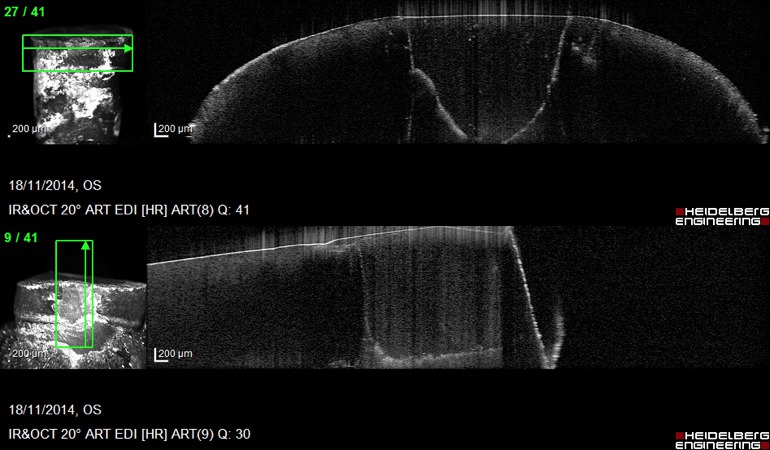
Methods: 16 intact upper premolars, extracted for periodontal reasons, were selected. A mesio-occluso-distal cavity with cervical margins placed 1mm below the CEJ was performed on each tooth. Samples were then all treated with Scotchbond Universal in etch-and-dry technique. Restoration was performed as follow: a 1mm horizontal layer of bulk-fill composite was placed over the mesial box cavity floor and cured for 20 sec with LED lamp. Then, a composite restoration was performed with oblique layering of nanohybrid resin composite. OCT (‘Spectralis’, Heidelberg-Engineering, Germany) imaging was performed after 24h and 10000 thermocycles. Marginal adaptation (percentage) was analyzed on 20 B-scans through each sample. Images were analyzed with the software ImageJ to assess the percentage of marginal gap between composite and cervical margin. The presence and the dimension of the gaps at the adhesive interfaces, after thermocycling and OCT evaluation, were also confirmed by CLSM. Data were statistically analyzed with 2-way ANOVA test and significance was set for p<0.05.
Results: ANOVA test showed that the interfacial adaptation was statistically influenced by the material employed (bulk-fill was better than composite), only before thermocycling, which significantly worsened the interfacial adaptation of bulk-fill material to dentin. CLSM closely confirmed OCT findings in all samples, because the interfacial adaptation analyzed by OCT corresponded to the interfacial adaptation analyzed by CLSM.
Conclusions: The null hypothesis is partially accepted since only the thermocycling significantly affected the interfacial adaptation of bulk-fill composites on dentin margin but did not affected composite adaptation.
The aim of this in vitro study was a non-invasive evaluation of the marginal sealing to dentin cervical margin of second class cavities after thermal aging using the optical coherence tomography (OCT). The null hypothesis is that there is no difference in marginal sealing between composites of different viscosity.
Methods: 16 intact upper premolars, extracted for periodontal reasons, were selected. A mesio-occluso-distal cavity with cervical margins placed 1mm below the CEJ was performed on each tooth. Samples were then all treated with Scotchbond Universal in etch-and-dry technique. Restoration was performed as follow: a 1mm horizontal layer of bulk-fill composite was placed over the mesial box cavity floor and cured for 20 sec with LED lamp. Then, a composite restoration was performed with oblique layering of nanohybrid resin composite. OCT (‘Spectralis’, Heidelberg-Engineering, Germany) imaging was performed after 24h and 10000 thermocycles. Marginal adaptation (percentage) was analyzed on 20 B-scans through each sample. Images were analyzed with the software ImageJ to assess the percentage of marginal gap between composite and cervical margin. The presence and the dimension of the gaps at the adhesive interfaces, after thermocycling and OCT evaluation, were also confirmed by CLSM. Data were statistically analyzed with 2-way ANOVA test and significance was set for p<0.05.
Results: ANOVA test showed that the interfacial adaptation was statistically influenced by the material employed (bulk-fill was better than composite), only before thermocycling, which significantly worsened the interfacial adaptation of bulk-fill material to dentin. CLSM closely confirmed OCT findings in all samples, because the interfacial adaptation analyzed by OCT corresponded to the interfacial adaptation analyzed by CLSM.
Conclusions: The null hypothesis is partially accepted since only the thermocycling significantly affected the interfacial adaptation of bulk-fill composites on dentin margin but did not affected composite adaptation.
IMAGES
2472513_File000000.jpg
2472513_File000000.jpg