IADR Abstract Archives
OCT Evaluation of Composite Restoration Resealing by Low-viscosity Resin Infiltration
Objectives: Low-viscosity light curing resins have been used as a micro-invasive treatment for caries infiltration; however, their properties as sealant for marginal gaps in restorations have not been extensively investigated. The aim of this study was to evaluate their efficacy as a sealant in terms of gap percentage reduction.
Methods: Tapered round cavities 4 mm in diameter and 2 mm in depth were prepared on sound bovine teeth, treated with an adhesive (Scotchbond Universal, 3M ESPE) and restored with a flowable resin composite (Estelite Flow Quick, Tokuyama Dental) in a single increment. Cross-sectional B-scan images were obtained after light curing of composite with swept-source optical coherence tomography (OCT, Santec). A low-viscosity resin (Icon, DMG) was applied to the enamel margins. OCT images were obtained again after application of the resin. The gap extent along thickness of enamel was calculated using an image analysis software, where the increased signal intensity at the interface was considered as gap. The data before and after infiltration were compared using paired t-test.
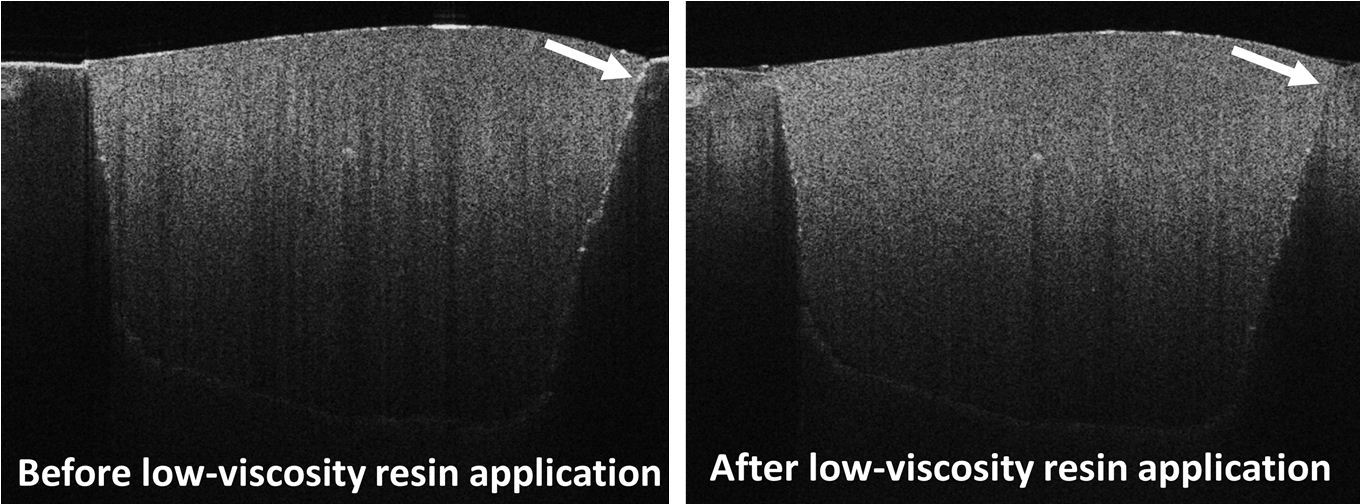
Results: OCT images showed remarkable reduction of backscatter signal at enamel margins after application of the low-viscosity resin. There was a significant difference in gap extent of enamel margins before and after the application of the low-viscosity resin (p<0.01). When enamel gap was present, the application if low-viscosity resin reduced the gap extent by 26.2% to 100% (mean reduction: 57.2%).
Conclusions: The low-viscosity resin could effectively infiltrate micro gaps formed at enamel margins and improve sealing of an existing composite restoration.
Methods: Tapered round cavities 4 mm in diameter and 2 mm in depth were prepared on sound bovine teeth, treated with an adhesive (Scotchbond Universal, 3M ESPE) and restored with a flowable resin composite (Estelite Flow Quick, Tokuyama Dental) in a single increment. Cross-sectional B-scan images were obtained after light curing of composite with swept-source optical coherence tomography (OCT, Santec). A low-viscosity resin (Icon, DMG) was applied to the enamel margins. OCT images were obtained again after application of the resin. The gap extent along thickness of enamel was calculated using an image analysis software, where the increased signal intensity at the interface was considered as gap. The data before and after infiltration were compared using paired t-test.
Results: OCT images showed remarkable reduction of backscatter signal at enamel margins after application of the low-viscosity resin. There was a significant difference in gap extent of enamel margins before and after the application of the low-viscosity resin (p<0.01). When enamel gap was present, the application if low-viscosity resin reduced the gap extent by 26.2% to 100% (mean reduction: 57.2%).
Conclusions: The low-viscosity resin could effectively infiltrate micro gaps formed at enamel margins and improve sealing of an existing composite restoration.
IMAGES
2472497_File000000.JPG
2472497_File000000.JPG