IADR Abstract Archives
Immunoexpression of STAT-3 and p38MAPK in the Different Clinical Types of Oral Lichen Planus: A Preliminary Study
Objectives: The signal transduction pathways, especially STAT-3 and p38MAPK, are involved as regulators and mediators in the pathogenesis of chronic inflammatory and immune disorders. Oral lichen planus (OLP) is a chronic inflammatory autoimmune disorder of unknown etiology. Some data suggest that an intricate intracellular signal transduction network maybe involved in the pathogenesis of OLP. The objective of this study was to examine the expression changed transduction factors in the process of OLP and found the association between their expression and the different clinical types.
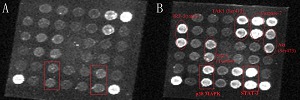
Methods: Collected OLP (n=10) and normal groups (n=8), obtained the oral mucosa and peripheral blood mononuclear cells (PBMCs) of each group. The PathScan analysis was carried out with the PathScan® Immune Cell Signaling Antibody Array kit and images of the slides were captured by using a fluorescent digital imaging system. Quantify spot intensities were detected with array image analysis software at last. The changes of the above transduction proteins expression more than 2 times were considered to have statistically differences in each group. Statistical analysis was performed by using the unpaired Student’s
Results: We found that, p38MAPK (Thr180/Tyr182) expression increased significantly in the reticular OLP (both P<0.001) compared to the control and erosive mucosa. However, in the erosive lesions, compared with the control and reticular mucosa, STAT-3 (Ser727) expression was significantly elevated (P<0.001 and P=0.002 respectively). Meanwhile, STAT-3 (Ser727) expression in the reticular OLP was higher compared to the normal control (P=0.001). In addition, the expression of p38MAPK and STAT-3 increased significantly in the PBMCs from the OLP patients, compared with the control (P=0.001 and P=0.006 respectively).
Conclusions: Collectively, our results demonstrate that p38MAPK (Thr180/Tyr182) and STAT-3 (Ser727), as important signal transduction factors, maybe involved in the process of OLP, especially account for the different secretion of cytokines and subsequent clinical manifestations of OLP.
Methods: Collected OLP (n=10) and normal groups (n=8), obtained the oral mucosa and peripheral blood mononuclear cells (PBMCs) of each group. The PathScan analysis was carried out with the PathScan® Immune Cell Signaling Antibody Array kit and images of the slides were captured by using a fluorescent digital imaging system. Quantify spot intensities were detected with array image analysis software at last. The changes of the above transduction proteins expression more than 2 times were considered to have statistically differences in each group. Statistical analysis was performed by using the unpaired Student’s
Results: We found that, p38MAPK (Thr180/Tyr182) expression increased significantly in the reticular OLP (both P<0.001) compared to the control and erosive mucosa. However, in the erosive lesions, compared with the control and reticular mucosa, STAT-3 (Ser727) expression was significantly elevated (P<0.001 and P=0.002 respectively). Meanwhile, STAT-3 (Ser727) expression in the reticular OLP was higher compared to the normal control (P=0.001). In addition, the expression of p38MAPK and STAT-3 increased significantly in the PBMCs from the OLP patients, compared with the control (P=0.001 and P=0.006 respectively).
Conclusions: Collectively, our results demonstrate that p38MAPK (Thr180/Tyr182) and STAT-3 (Ser727), as important signal transduction factors, maybe involved in the process of OLP, especially account for the different secretion of cytokines and subsequent clinical manifestations of OLP.
IMAGES
2472094_File000002.jpg
2472094_File000004.jpg
2472094_File000002.jpg
2472094_File000004.jpg