IADR Abstract Archives
Self-assembly Human Amelogenin Induced Parallel Crystals Boundless in Vitro
Objectives: Purified recombinant human amelogenin(Am) and observed their aggregation phenomenon through cryo electron microscopy, their function of controlling mineralization in biomimetic calcification solution.
Methods: The full-length human amelogenin was isolated and purified from developing tooth buds of potential orthodontic treatment child. The composition has been previously defined by SDS-gel and electroscopy mass spectroscopy. Protein lyophilized stock solutions were prepared by dissolution in distilled water(pH 3.5) at the concentration of 10 mg/mL. The solution were added to 4mM PBS (pH8.0) to establish a final protein concentration of 100 μg/ml and observed in FEI Tecnai F20 electron microscope. Amelogenins were mixed with CaCl2 with Na2HPO4 solution which final protein concentration were 0.2 mg/ml, 1mM phosphate and 1.67 mM Ca2+. The samples incubated at 37°C in a humidity chamber at 10, 60 min and 1day, then viewed on Tecnai TEM.
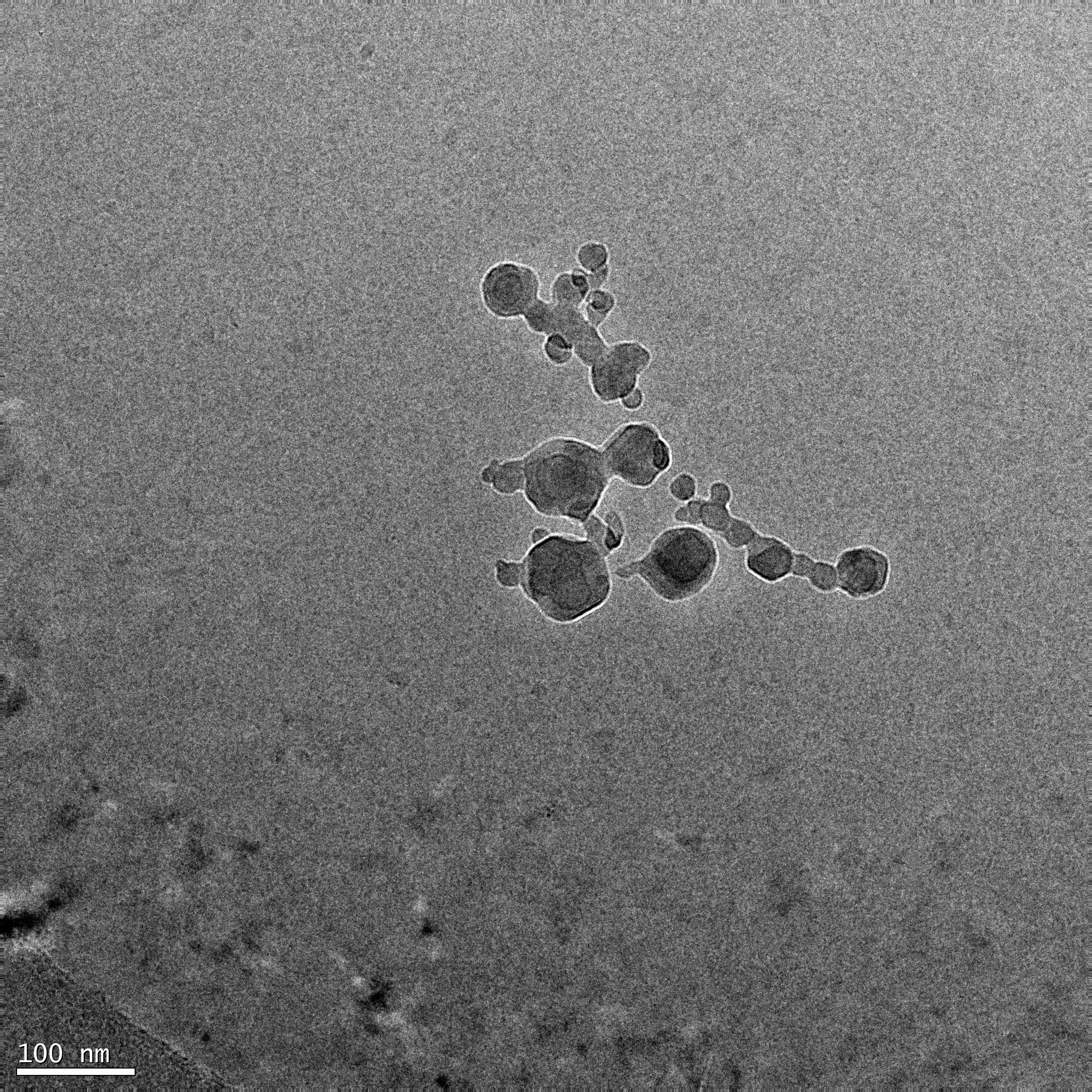
Results: The measured molecular weights of Am was 25kD which were within 2 Daltons of pre-dicted values. Tiny particles fromed 3-5nm distributed which were identified as amelogenin monomers. Monomers and oligomers becomes increasingly intense which present larger ring-like structure included 6-8 monomers and the diameter from 5-10nm in 10 min. After 20min, 10-40nm nanospheres were aggregates. The oligomers and nanospheres formed nanochains and net which were the basic unite of Am(Fig.1). Mineralization experiments revealed that small isolated mineral clusters with average size of 2 nm were formed after 10 min, 2–3 particles along with isolated particles appear after 60 min. One day later, short linear chains of clusters started to fuse together and formed needle-like elongated mineral particles which similar to the hydroxyapatite in enamel rod.
Conclusions: The human Am has the potential to control calcium phosphate polymorphism, promote parallel crystal organization and modulate crystal morphology in vitro. It can be used as a potential effective crystal growth modifiers.
Methods: The full-length human amelogenin was isolated and purified from developing tooth buds of potential orthodontic treatment child. The composition has been previously defined by SDS-gel and electroscopy mass spectroscopy. Protein lyophilized stock solutions were prepared by dissolution in distilled water(pH 3.5) at the concentration of 10 mg/mL. The solution were added to 4mM PBS (pH8.0) to establish a final protein concentration of 100 μg/ml and observed in FEI Tecnai F20 electron microscope. Amelogenins were mixed with CaCl2 with Na2HPO4 solution which final protein concentration were 0.2 mg/ml, 1mM phosphate and 1.67 mM Ca2+. The samples incubated at 37°C in a humidity chamber at 10, 60 min and 1day, then viewed on Tecnai TEM.
Results: The measured molecular weights of Am was 25kD which were within 2 Daltons of pre-dicted values. Tiny particles fromed 3-5nm distributed which were identified as amelogenin monomers. Monomers and oligomers becomes increasingly intense which present larger ring-like structure included 6-8 monomers and the diameter from 5-10nm in 10 min. After 20min, 10-40nm nanospheres were aggregates. The oligomers and nanospheres formed nanochains and net which were the basic unite of Am(Fig.1). Mineralization experiments revealed that small isolated mineral clusters with average size of 2 nm were formed after 10 min, 2–3 particles along with isolated particles appear after 60 min. One day later, short linear chains of clusters started to fuse together and formed needle-like elongated mineral particles which similar to the hydroxyapatite in enamel rod.
Conclusions: The human Am has the potential to control calcium phosphate polymorphism, promote parallel crystal organization and modulate crystal morphology in vitro. It can be used as a potential effective crystal growth modifiers.
IMAGES
2472092_File000000.jpg
2472092_File000000.jpg