IADR Abstract Archives
A WNT Therapeutic to Activate Endogenous Stem Cells for Improved Bone Healing
Objectives: To understand how the natural process of aging affects stem and osteoprogenitor cell potential, and how these variables in turm impact bone healing potential. Additonally, to demonstrate the efficacy of a WNT protein therapeutic to accelerate bone healing even in difficult cases such as those involving osteonecrotic lesions.
Methods: Non-critical size skeletal defects were coupled with cryogenic injury to create non-healing, osteonecrotic defects in Wnt reporter mice. Immunostaining for the reporter gene verified the initial presence of Wnt responsive cells in control skeletal defects, and a reduction in the population of Wnt responsive cells in osteonecrotic defects. Osteonecrotic defects were treated with autologous bone grafts (autografts); control osteonecrotic defects received autografts alone whereas the test group received autografts that had been treated ex vivo with liposomal WNT3A protein (L-WNT3A). In vivo µCT monitored healing over time and immunohistochemistry were used to track the fate of cells from the autograft, and to assess their capacity to repair osteonecrotic defects according to age and WNT activation status.
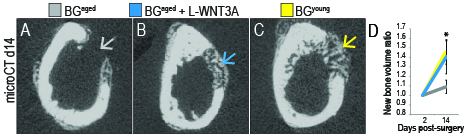
Results: First, we demonstrate that cells from an autograft directly contribute to repair of an osteonecrotic lesion. Second, we present data showing that this contribution diminishes as the age of the animal increases (compare Fig. 1A and B). Third, axial micro-CT data demonstrate that pre-treating aged autografts with L-WNT3A restored osteogenic expression and osteogenic capacity, back to levels appreciated in autografts from young animals (Fig. 1C where N>4 for each condition; quantified in D). Finally, the resulting bony regenerate in the L-WNT3A group is indistinguishable from native, intact bone.
Conclusions: First, these data demonstrate that Wnt signaling is activated by skeletal injury. Second, osteonecrotic defects that fail to heal spontaneously show diminished endogenous Wnt activity. Third, our data demonstrate that in a compromised environment associated with osteonecrosis, L-WNT3A treatment results in the restoration of skeletal integrity. Collectively, these data demonstrate the overall structural integrity of the skeleton is improved by transiently elevating Wnt at the site of damage, even in severe cases of osteonecrosis.
Methods: Non-critical size skeletal defects were coupled with cryogenic injury to create non-healing, osteonecrotic defects in Wnt reporter mice. Immunostaining for the reporter gene verified the initial presence of Wnt responsive cells in control skeletal defects, and a reduction in the population of Wnt responsive cells in osteonecrotic defects. Osteonecrotic defects were treated with autologous bone grafts (autografts); control osteonecrotic defects received autografts alone whereas the test group received autografts that had been treated ex vivo with liposomal WNT3A protein (L-WNT3A). In vivo µCT monitored healing over time and immunohistochemistry were used to track the fate of cells from the autograft, and to assess their capacity to repair osteonecrotic defects according to age and WNT activation status.
Results: First, we demonstrate that cells from an autograft directly contribute to repair of an osteonecrotic lesion. Second, we present data showing that this contribution diminishes as the age of the animal increases (compare Fig. 1A and B). Third, axial micro-CT data demonstrate that pre-treating aged autografts with L-WNT3A restored osteogenic expression and osteogenic capacity, back to levels appreciated in autografts from young animals (Fig. 1C where N>4 for each condition; quantified in D). Finally, the resulting bony regenerate in the L-WNT3A group is indistinguishable from native, intact bone.
Conclusions: First, these data demonstrate that Wnt signaling is activated by skeletal injury. Second, osteonecrotic defects that fail to heal spontaneously show diminished endogenous Wnt activity. Third, our data demonstrate that in a compromised environment associated with osteonecrosis, L-WNT3A treatment results in the restoration of skeletal integrity. Collectively, these data demonstrate the overall structural integrity of the skeleton is improved by transiently elevating Wnt at the site of damage, even in severe cases of osteonecrosis.
IMAGES
2471525_File000000.jpg
2471525_File000000.jpg