IADR Abstract Archives
Ability of Depth-of-cure and Degree-of-monomer-conversion to-assess Curing of a Polymer-based-restorative-material
Objectives: This study investigated how the standard depth-of-cure(DOC) test ranked the ability of several different brands of LED-curing-units(LCU) to cure a polymer-based-restorative-material(PBRM) compared to degree-of-monomer-conversion(DOMC).
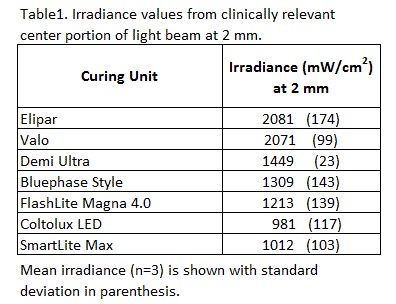
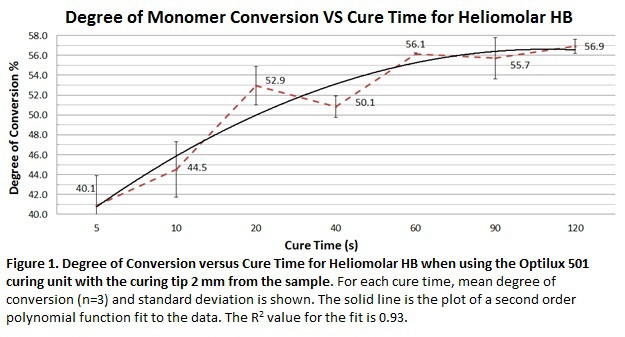
Methods: Seven-different LCUs were used in the study(Table1). For each LCU, the radiant-power striking the surface of a 3.9mm-diameter “irradiance-probe”(IP) was measured with the tip of the LCU centered 2mm over the IP. The IP consisted of a cosine-corrector connected to a fiber-optic-cable and a spectrometer calibrated using a NIST-traceable-light-source. For all tests, Heliomolar-HB-Shade-A2 was used along with a 20-second cure-time recommended by the manufacturer. Using a 4mm-diameter-mold, DOC tests were performed based on the test-method specified in ISO-standard-4049, with the curing-tip 2mm from the surface of the PBRM. The DOMC of the PBRM was determined using Fourier-transform-infrared(FTIR) analysis. Uncured-PBRM was placed in a 6mm-diameter by 2mm-high Teflon-mold. The mold was centered over a diamond-horizontal-attenuated-total-reflectance(HATR) crystal on the FTIR. After the uncured-PBRM-spectrum was collected, a LCU was centered 2mm above the sample and diamond-HATR-crystal and the PBRM was cured for 20-seconds. From the FTIR-spectra, the intensities of the aliphatic carbon-carbon-double-bonds(CCDB) absorbance peak at 1637cm-1 and the aromatic-absorbance-peak at 1608cm-1 were determined for both the uncured and cured PBRM using a baseline-technique that connected-troughs on either-side of both the aliphatic and aromatic peaks and measured the respective-peak-heights from the baselines(C-peak-method). The percent of unreacted-CCDB remaining after curing can be calculated by comparing the ratio of the aliphatic-peak-height to the aromatic-peak-height before and after curing. DOMC is obtained by subtracting the percent of unreacted-CCDB from 100%. To put DOMC-values in-perspective, DOMC for HeliomolarHB was measured versus curing-time and plotted(Fig1).
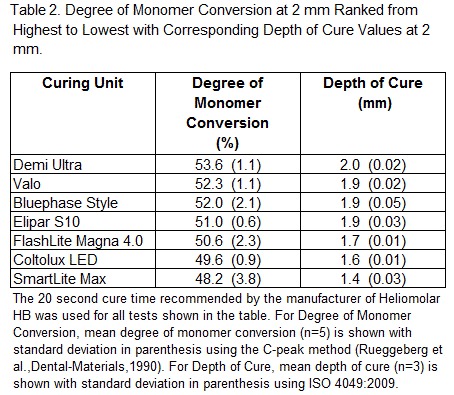
Results: For the different LCUs, Table1 shows irradiance-measurements and Table2 shows the DOMC-values ranked from highest-to-lowest with corresponding DOC-values.
Conclusions: When comparing the ability of seven-different LCUs to cure a PBRM, the rankings from highest-to-lowest are consistent for both DOMC and DOC.
Methods: Seven-different LCUs were used in the study(Table1). For each LCU, the radiant-power striking the surface of a 3.9mm-diameter “irradiance-probe”(IP) was measured with the tip of the LCU centered 2mm over the IP. The IP consisted of a cosine-corrector connected to a fiber-optic-cable and a spectrometer calibrated using a NIST-traceable-light-source. For all tests, Heliomolar-HB-Shade-A2 was used along with a 20-second cure-time recommended by the manufacturer. Using a 4mm-diameter-mold, DOC tests were performed based on the test-method specified in ISO-standard-4049, with the curing-tip 2mm from the surface of the PBRM. The DOMC of the PBRM was determined using Fourier-transform-infrared(FTIR) analysis. Uncured-PBRM was placed in a 6mm-diameter by 2mm-high Teflon-mold. The mold was centered over a diamond-horizontal-attenuated-total-reflectance(HATR) crystal on the FTIR. After the uncured-PBRM-spectrum was collected, a LCU was centered 2mm above the sample and diamond-HATR-crystal and the PBRM was cured for 20-seconds. From the FTIR-spectra, the intensities of the aliphatic carbon-carbon-double-bonds(CCDB) absorbance peak at 1637cm-1 and the aromatic-absorbance-peak at 1608cm-1 were determined for both the uncured and cured PBRM using a baseline-technique that connected-troughs on either-side of both the aliphatic and aromatic peaks and measured the respective-peak-heights from the baselines(C-peak-method). The percent of unreacted-CCDB remaining after curing can be calculated by comparing the ratio of the aliphatic-peak-height to the aromatic-peak-height before and after curing. DOMC is obtained by subtracting the percent of unreacted-CCDB from 100%. To put DOMC-values in-perspective, DOMC for HeliomolarHB was measured versus curing-time and plotted(Fig1).
Results: For the different LCUs, Table1 shows irradiance-measurements and Table2 shows the DOMC-values ranked from highest-to-lowest with corresponding DOC-values.
Conclusions: When comparing the ability of seven-different LCUs to cure a PBRM, the rankings from highest-to-lowest are consistent for both DOMC and DOC.
IMAGES
2123219_File000000.jpg
2123219_File000001.jpg
2123219_File000002.jpg
2123219_File000000.jpg
2123219_File000001.jpg
2123219_File000002.jpg