IADR Abstract Archives
The Osseointegration Potential of Dental Implants Following Surface Modification
Objectives: It has been revealed that texturing the implant surface is the most utilized feature for effectively and efficiently improving host-to-implant response. Acid etching (AE), is a technique that physically changes the surface by applying a strong acid (hydrochloric, nitric, sulfuric acids) to augment topography. The technique has shown to enhance surface area and thus osseointegration. The use of bioactive ceramics coatings, such as calcium phosphate, is a chemical alteration that received significant attention since these elements are native in natural bone and demonstrated higher osteoconductive properties. The objective of the study was to investigate the osteoconductive potential and efficacy of calcium carbonate (CaCO3) coated implants in comparison to non-treated (smooth machined) and acid etched treated implants.
Methods: Skeletally mature female Dorset/Finn crossbred sheep were used during the study. Grade V Titanium implants were drilled flush with the hip surface in the left and right iliac locations for 2 and 6 week time points.Excised tissue samples were then dehydrated in a series of alcohol washes and embedded in MMA prior to histological processing. Sliced samples were polished to an approximate 100 micron thickness and stained with a Stevenel’s Blue/Van Gieson stain. Each slide was digitally scanned through the Aperio scanning system. Analysis consisted of Bone to Implant Contact (BIC), Bone Area Fraction Occupancy (BAFO) and torque-out test.
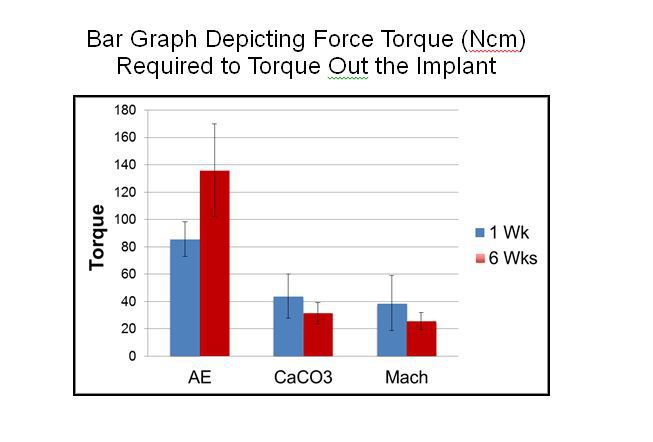
Results: Grossly, there were no signs of tissue inflammation or infection for any animals throughout the course of the study. Histological analysis showed no signs of an immunogenic response. There was a significant increase in BAFO from 2 to 6 weeks (p<0.05) for the CaCO3 coated implants, as opposed to the acid etched and control group. Torque-out test results were highest for the acid etched group. Figure 1 shows the amount of force required to loosen the implants.
Conclusions: There was less torque needed to loosen the CaCO3 implants post six weeks. It was hypothesized that the experimental would have similar results to AE, hence this hypothesis is not accepted. Percent change in BAFO values were significantly higher for CaCO3 values then other groups.
Methods: Skeletally mature female Dorset/Finn crossbred sheep were used during the study. Grade V Titanium implants were drilled flush with the hip surface in the left and right iliac locations for 2 and 6 week time points.Excised tissue samples were then dehydrated in a series of alcohol washes and embedded in MMA prior to histological processing. Sliced samples were polished to an approximate 100 micron thickness and stained with a Stevenel’s Blue/Van Gieson stain. Each slide was digitally scanned through the Aperio scanning system. Analysis consisted of Bone to Implant Contact (BIC), Bone Area Fraction Occupancy (BAFO) and torque-out test.
Results: Grossly, there were no signs of tissue inflammation or infection for any animals throughout the course of the study. Histological analysis showed no signs of an immunogenic response. There was a significant increase in BAFO from 2 to 6 weeks (p<0.05) for the CaCO3 coated implants, as opposed to the acid etched and control group. Torque-out test results were highest for the acid etched group. Figure 1 shows the amount of force required to loosen the implants.
Conclusions: There was less torque needed to loosen the CaCO3 implants post six weeks. It was hypothesized that the experimental would have similar results to AE, hence this hypothesis is not accepted. Percent change in BAFO values were significantly higher for CaCO3 values then other groups.
IMAGES
2122756_File000000.JPG
2122756_File000000.JPG