IADR Abstract Archives
Material-related Recommendations for the Use of a Glassionomer-based Restorative System in Class II Cavities. A Mechanical Test
Objectives: The purpose of this study was to demonstrate material related recommendations for the use of a high-vscosity glassionomer-based restorative system in a class II cavity, by predefined cavity preparations and the use of partial or straight matrix systems. Therefore it was aimed to evaluate if a certain design of the platform within the Class II cavity preparation and the use of a certain partial matrices system reach higher mechanical values in fracture toughness.
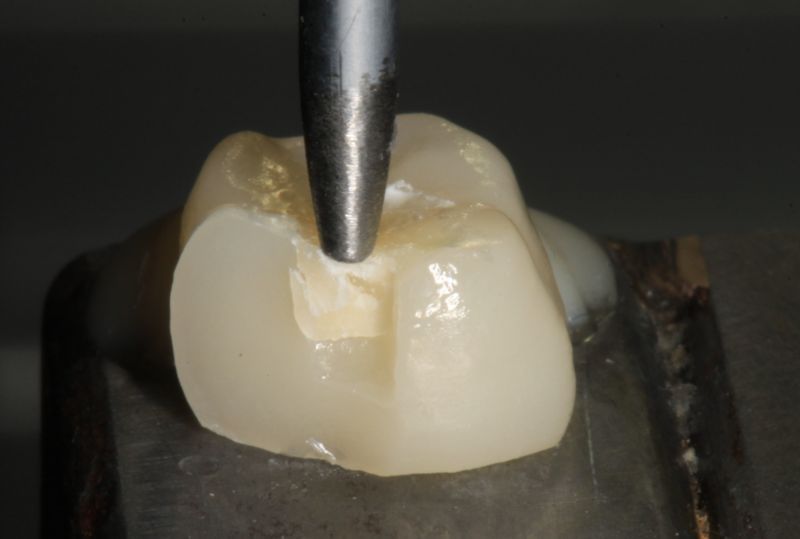
Methods: 40 artificial teeth made with ZirPress material (Ivoclar Vivadent AG, Liechtenstein) with 2 different Class II preparations (n=20 of 90° walls of internal step, sharp edges; and n= 20 of 120° walls, rounded edges). Then, four groups were randomly created: Group A: 90 degree (sharp-edge) internal step + partial curved (sectional) matrices system; Group B: 120 degree (rounded-edge) internal step + partial curved matrices system; Group C: 90 degree (sharp-edge) internal step + Automatrix (Dentsply, USA) straight system; Group D: 120 degree (rounded-edge) internal step + Automatrix straight system. Then the cavities were restored in both groups using a high viscosity glassionomer restorative system (Equia, GC Corporation, Japan; Shade A3) using a custom-made silicon mould to reproduce the same shape of restoration in all specimens. The specimens were then subjected to an axial compression test in a universal testing machine, using a 1.2 mm diameter, rounded tip probe.
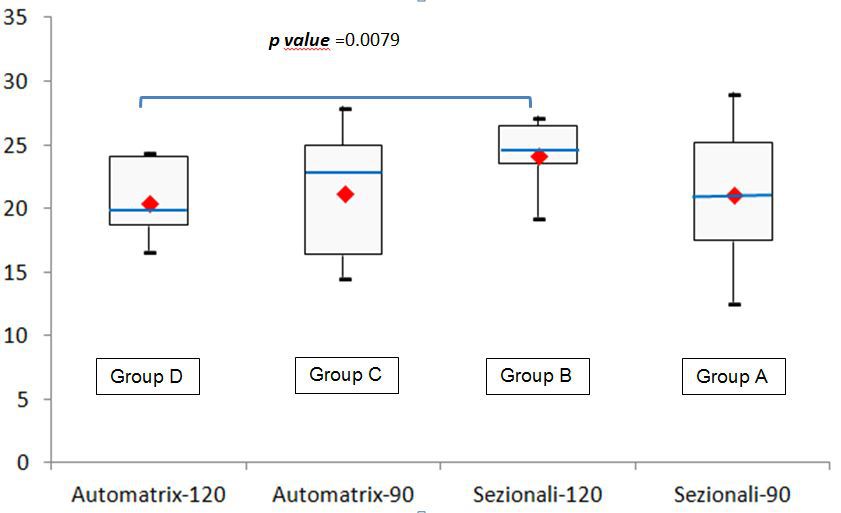
Results: All groups requested medium/high forces to fracture the GIC restorations (average 20-25 DaN). All fractures were cohesive. Group B (120°+Sectional matrix) required the highest average force to obtain fracture of restorations. The difference between Group B and Group D (which used the same cavity design but straight matices) was statistically significant (p=0,0079). No statistical differences were found between the other groups.
Conclusions: Group B (120° rounded cavity design combined with sectional matrices) showed better mechanical behavior under vertical forces simulating “in vivo” occlusal forces. Better behavior of Group B is probably related to a combination of good distribution of forces inside the material (due to absence of sharp edges) and shape of the vertical wall created with the sectional matrices (well sustaining the marginal crest and preventing breakdown).
Methods: 40 artificial teeth made with ZirPress material (Ivoclar Vivadent AG, Liechtenstein) with 2 different Class II preparations (n=20 of 90° walls of internal step, sharp edges; and n= 20 of 120° walls, rounded edges). Then, four groups were randomly created: Group A: 90 degree (sharp-edge) internal step + partial curved (sectional) matrices system; Group B: 120 degree (rounded-edge) internal step + partial curved matrices system; Group C: 90 degree (sharp-edge) internal step + Automatrix (Dentsply, USA) straight system; Group D: 120 degree (rounded-edge) internal step + Automatrix straight system. Then the cavities were restored in both groups using a high viscosity glassionomer restorative system (Equia, GC Corporation, Japan; Shade A3) using a custom-made silicon mould to reproduce the same shape of restoration in all specimens. The specimens were then subjected to an axial compression test in a universal testing machine, using a 1.2 mm diameter, rounded tip probe.
Results: All groups requested medium/high forces to fracture the GIC restorations (average 20-25 DaN). All fractures were cohesive. Group B (120°+Sectional matrix) required the highest average force to obtain fracture of restorations. The difference between Group B and Group D (which used the same cavity design but straight matices) was statistically significant (p=0,0079). No statistical differences were found between the other groups.
Conclusions: Group B (120° rounded cavity design combined with sectional matrices) showed better mechanical behavior under vertical forces simulating “in vivo” occlusal forces. Better behavior of Group B is probably related to a combination of good distribution of forces inside the material (due to absence of sharp edges) and shape of the vertical wall created with the sectional matrices (well sustaining the marginal crest and preventing breakdown).
IMAGES
2120549_File000000.jpg
2120549_File000001.jpg
2120549_File000000.jpg
2120549_File000001.jpg