IADR Abstract Archives
A Biomechanical Method for Predicting Dental Caries
Objectives: Dental caries is the most prevalent chronic disease worldwide despite advances in preventive care. Successful minimally invasive interventions of incipient enamel caries lesions decrease the need for surgical dental restorations. Minimally invasive interventions are mostly performed by chemical agents, proper oral hygiene and reduced sugar intake. However, there is commonly no prediction tool for the enamel caries progression, nor is there any framework to obtain the optimal time of intervention. The objective is to establish a time-based biological-mechanical method for predicting caries progression and remineralization potential.
Methods: For modeling, a non-isotropic material definition expressing the effective elastic properties for healthy, non-decayed enamel is used. To model enamel decay, the stiffness were reduced to 75%, 50%, or 25% of the healthy values, respectively, resulting in a softened material. Materials were assigned to the model in four decay cases; a completely healthy model was created and followed by models with minimal, intermediate, and advanced decay, respectively. Materials at 100%, 75%, 50%, and 25% of the stiffness were assigned to the ring partitions of the model to simulate decay progressing from the outer surface inward.
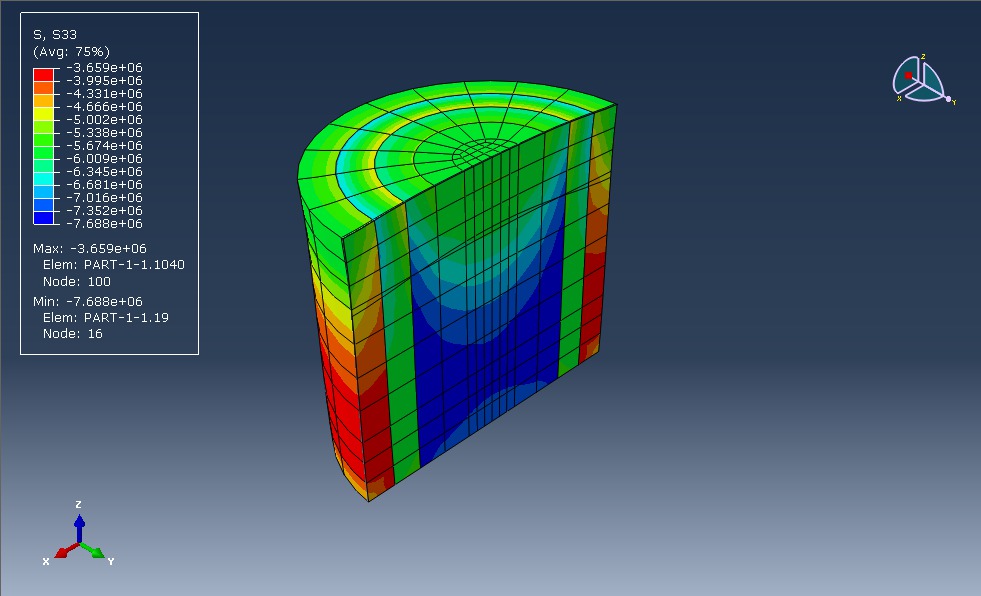
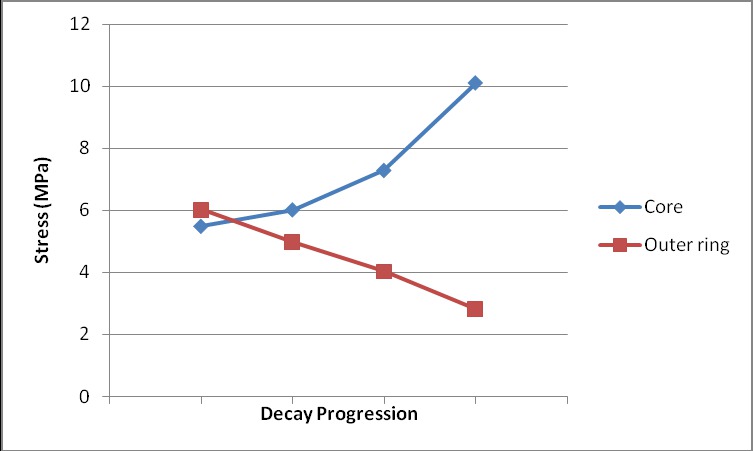
Results: For a material of given stiffness, the induced stress will always increase as decay progresses. This can be observed for the healthy core induced stress as decay progresses (Figures 1,2). It is also observed that the outer ring’s ability to carry load reduces as decay progresses. As it weakens, its share of the load is transferred to the healthier regions, resulting in decreasing stress.
Conclusions: Prediction of enamel caries progression is proposed through development of a framework that uses a hybrid analytical-experimental procedure. This time-based biological-mechanical method is capable of predicting caries progression and remineralization potential of enamel. This prediction can ultimately be used to obtain optimal time intervals for intervention and development of new preventive therapies.
Methods: For modeling, a non-isotropic material definition expressing the effective elastic properties for healthy, non-decayed enamel is used. To model enamel decay, the stiffness were reduced to 75%, 50%, or 25% of the healthy values, respectively, resulting in a softened material. Materials were assigned to the model in four decay cases; a completely healthy model was created and followed by models with minimal, intermediate, and advanced decay, respectively. Materials at 100%, 75%, 50%, and 25% of the stiffness were assigned to the ring partitions of the model to simulate decay progressing from the outer surface inward.
Results: For a material of given stiffness, the induced stress will always increase as decay progresses. This can be observed for the healthy core induced stress as decay progresses (Figures 1,2). It is also observed that the outer ring’s ability to carry load reduces as decay progresses. As it weakens, its share of the load is transferred to the healthier regions, resulting in decreasing stress.
Conclusions: Prediction of enamel caries progression is proposed through development of a framework that uses a hybrid analytical-experimental procedure. This time-based biological-mechanical method is capable of predicting caries progression and remineralization potential of enamel. This prediction can ultimately be used to obtain optimal time intervals for intervention and development of new preventive therapies.
IMAGES
2117306_File000003.jpg
2117306_File000002.jpg
2117306_File000003.jpg
2117306_File000002.jpg