IADR Abstract Archives
Interaction of Camphorquinone Photo-Initiator With Energy Delivered From LED Curing-Units
Objectives: When plotted with-respect to wavelength, spectral-irradiance-curves can express the relative-amount of power coming-from a visible-light-curing-unit at each wavelength. A dental-curing-unit must emit a sufficient amount of energy at the proper-wavelengths to adequately-cure a photo-polymerizable-material. The objective of this study was to quantify the amount-of-energy delivered by various LED-curing-units(LCU) that interacts with the camphorquinone(CQ)-photo-initiator of a resin-based-composite-material(RBCM) and relate this to each unit’s ability to cure in terms of depth-of-cure(DOC) and monomer-conversion.
Methods: Spectral-distribution-measurements(SDM) were obtained for seven different LCU using an irradiance-probe consisting of a cosine-corrector connected to a fiber-optic-cable and a spectrometer calibrated using a NIST-traceable light-source. SDM were made by centering the tip of each LCU over the irradiance-probe at 2mm from the surface of its diffusing-material. For each LCU, the percentage of its spectral-emission-curve(SEC) that overlapped the peak-absorption-range(PAR) of a normalized CQ-absorption-curve was calculated as the “peak-absorption-percentage“(PAP). “Effective-irradiance”(EI) was also calculated, which is defined as the area of the curing-unit’s (SEC) that overlapped the PAR for CQ, and reported in mW/cm2. EI was multiplied by curing-time to obtain “effective-energy”. DOC tests were performed based on ISO-standard 4049:2009, and monomer-conversion tests were performed by means of Fourier-transform-infrared-spectroscopy-analysis. Heliomolar-HB(A2-shade) was the RBCM used for both tests.
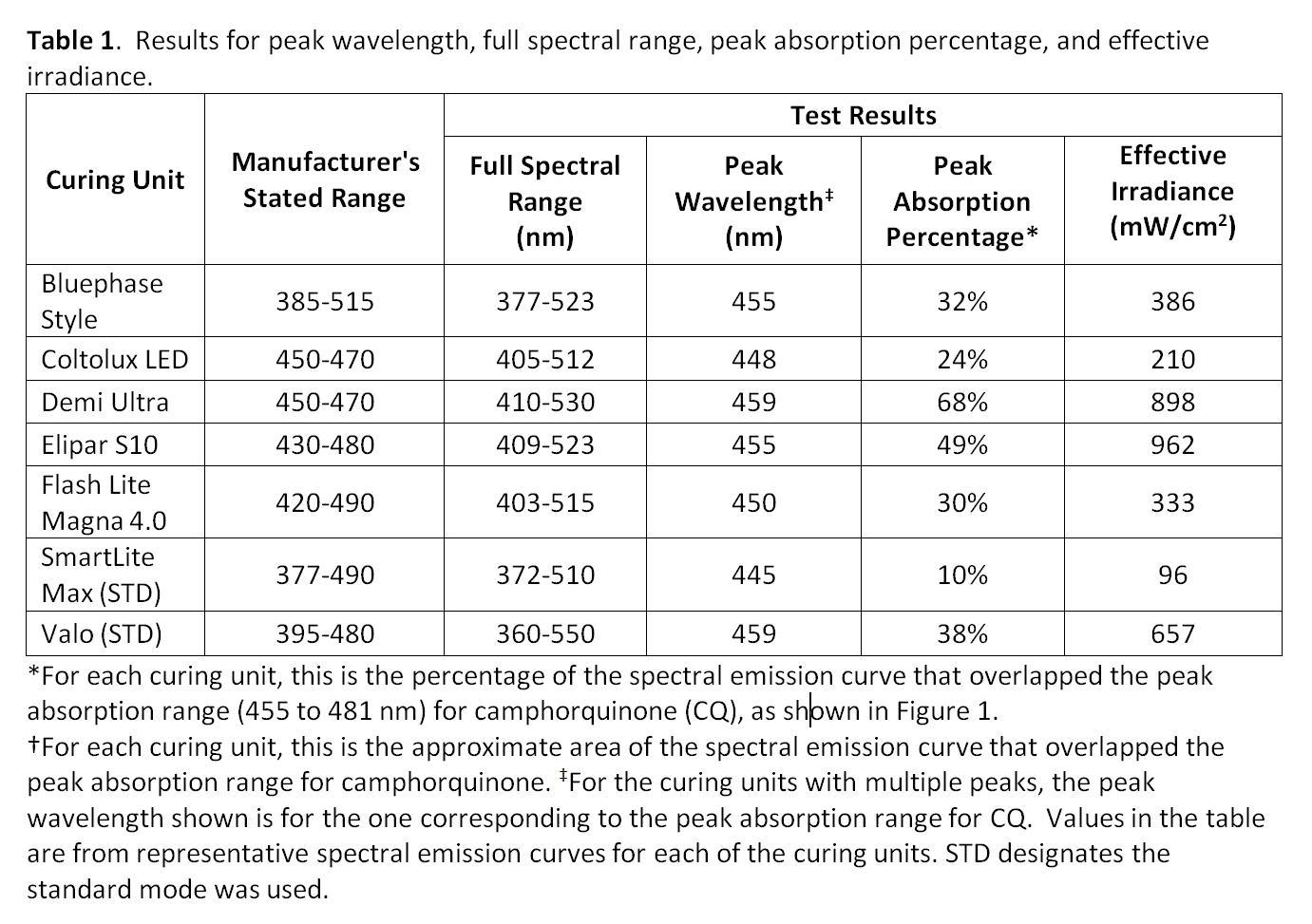
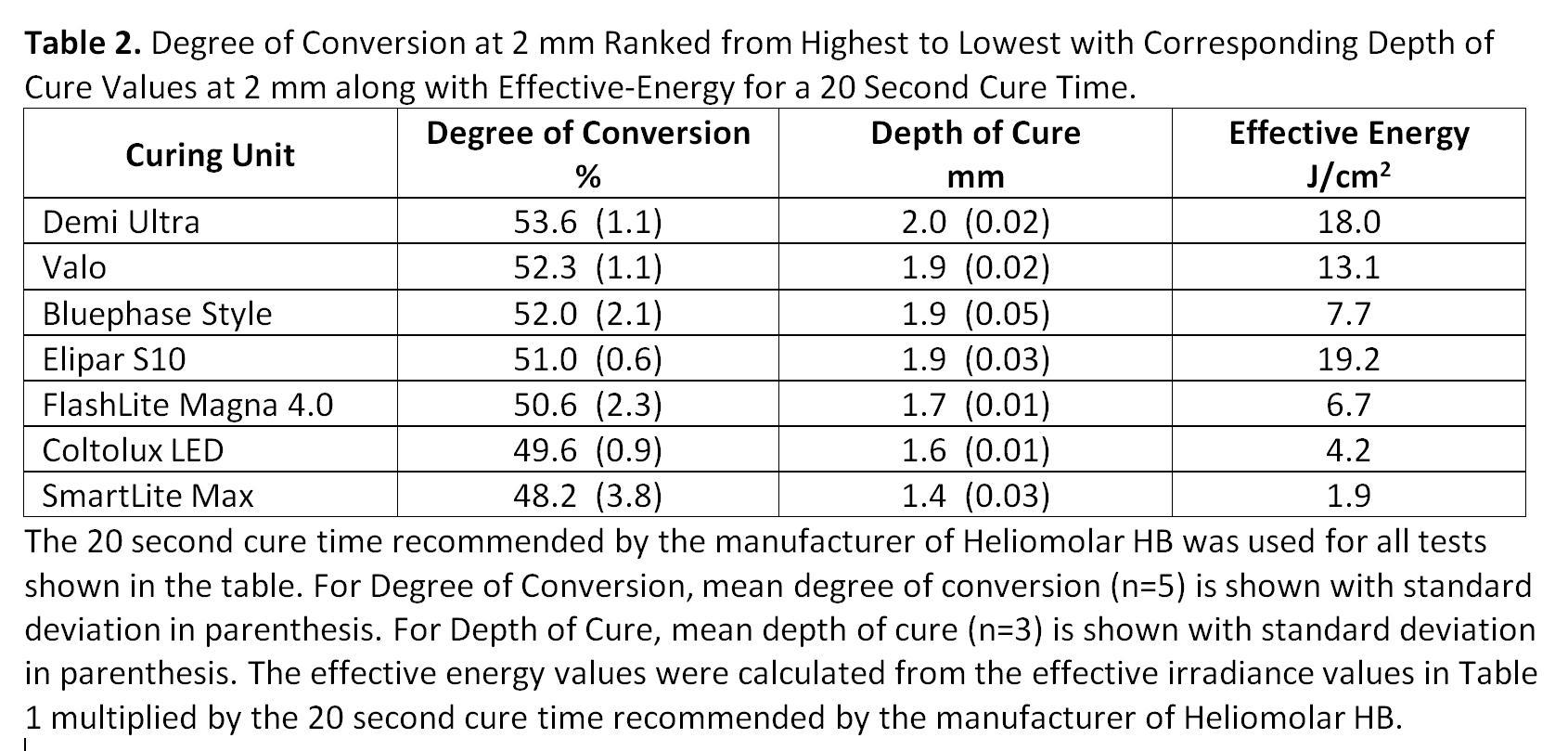
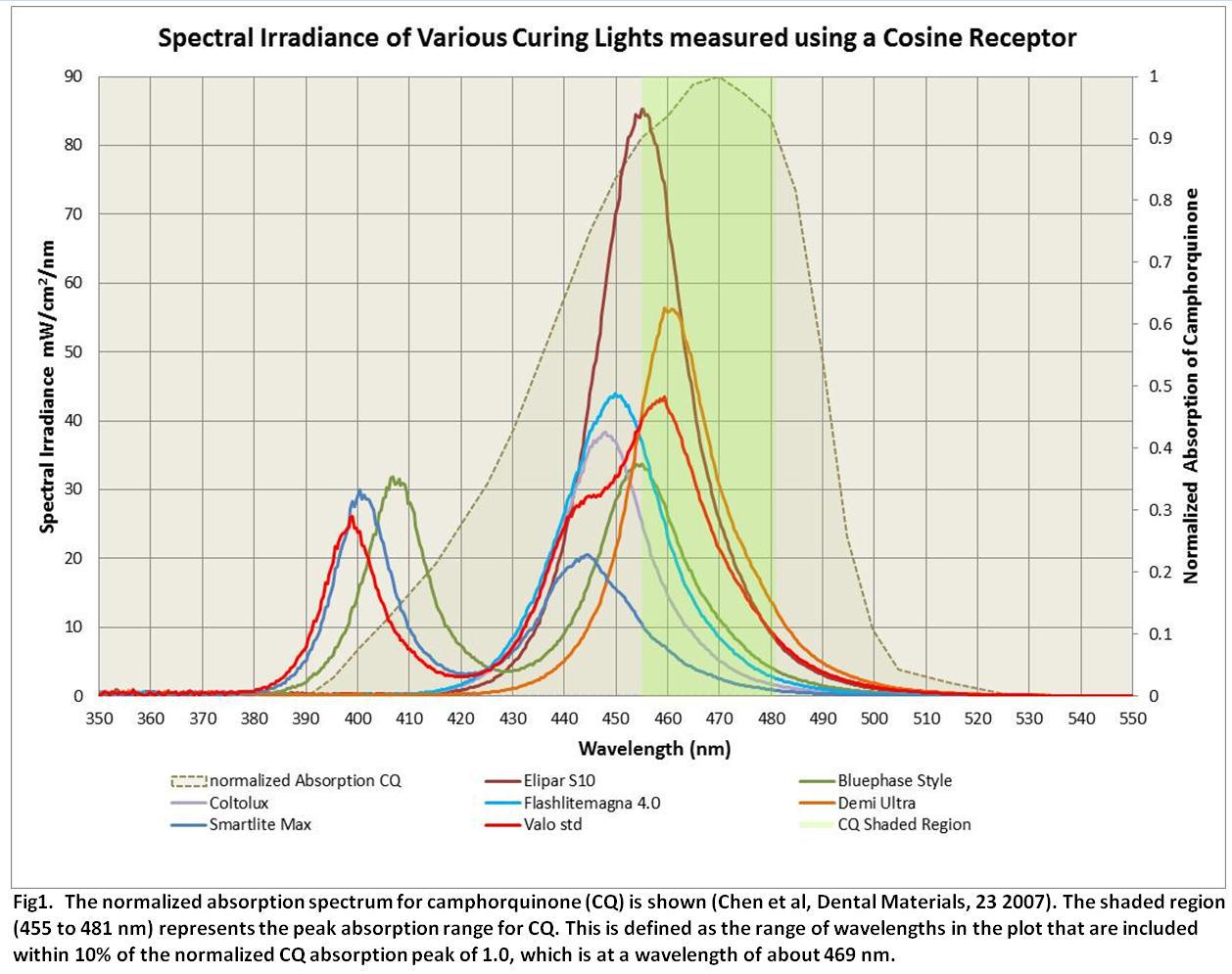
Results: In Figure1, it can be seen that the spectral-irradiance-curves for the different curing-units overlap the region representing the PAR of CQ to a varying-degree, with the PAP and EI given in Table1. Table2 compares degree-of-conversion, depth-of-cure, and effective-energy.
Conclusions: In this study, PAP, EI, and effective-energy were defined and calculated. It was shown that these values can be used to provide a theoretical-estimate of the amount-of-energy delivered to a RBCM from an LCU that is able to optimally-interact with the material’s CQ-photo-initiator. For several LCUs, calculated energy-values were compared to the ability of each-unit to cure in terms of DOC and monomer-conversion.
Methods: Spectral-distribution-measurements(SDM) were obtained for seven different LCU using an irradiance-probe consisting of a cosine-corrector connected to a fiber-optic-cable and a spectrometer calibrated using a NIST-traceable light-source. SDM were made by centering the tip of each LCU over the irradiance-probe at 2mm from the surface of its diffusing-material. For each LCU, the percentage of its spectral-emission-curve(SEC) that overlapped the peak-absorption-range(PAR) of a normalized CQ-absorption-curve was calculated as the “peak-absorption-percentage“(PAP). “Effective-irradiance”(EI) was also calculated, which is defined as the area of the curing-unit’s (SEC) that overlapped the PAR for CQ, and reported in mW/cm2. EI was multiplied by curing-time to obtain “effective-energy”. DOC tests were performed based on ISO-standard 4049:2009, and monomer-conversion tests were performed by means of Fourier-transform-infrared-spectroscopy-analysis. Heliomolar-HB(A2-shade) was the RBCM used for both tests.
Results: In Figure1, it can be seen that the spectral-irradiance-curves for the different curing-units overlap the region representing the PAR of CQ to a varying-degree, with the PAP and EI given in Table1. Table2 compares degree-of-conversion, depth-of-cure, and effective-energy.
Conclusions: In this study, PAP, EI, and effective-energy were defined and calculated. It was shown that these values can be used to provide a theoretical-estimate of the amount-of-energy delivered to a RBCM from an LCU that is able to optimally-interact with the material’s CQ-photo-initiator. For several LCUs, calculated energy-values were compared to the ability of each-unit to cure in terms of DOC and monomer-conversion.
IMAGES
2114482_File000000.jpg
2114482_File000001.jpg
2114482_File000002.jpg
2114482_File000000.jpg
2114482_File000001.jpg
2114482_File000002.jpg