IADR Abstract Archives
BMI as a Potential Risk Factor for Deciduous Dental Caries
Objectives: The inconsistent association between body mass index (BMI) and dental caries may be attributed to the differences in how studies have classified BMI. The current study explores the relationships between various classifications of BMI and incident dental caries in a high-caries risk population.
Methods: Infants were recruited from Uniontown, Alabama. This rural community is comprised of low socioeconomic status African Americans, constituting it a high-caries risk group. They were observed annually for 4 years whereby dental caries, BMI (using age and gender specific percentiles), and socio-demographics data were obtained through visual exams, height/weight checks, and questionnaires, respectively. Utilizing a nested, case-control study design, cases had positive dmfs change scores while controls had no change in scores for yearly intervals (N = 127). Sex-stratified, logistic regression models, adjusted for full-term birth status, were employed with each different BMI variable (overweight/obese vs. not overweight/obese; continuous BMI; multi-level BMI: underweight; normal, overweight, obese); odds ratios and 95% confidence intervals were calculated.
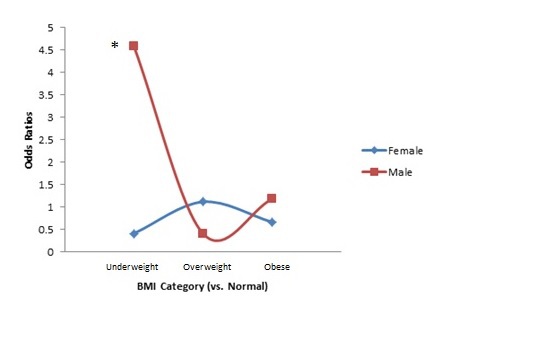
Results: When comparing “overweight/obese vs. not overweight/obese”, there was a protective association for males and a slight increase in odds of dental caries for females. Assuming a linear association, a continuous BMI produced similar odds ratios across strata (Table 1). Utilizing a multi-level variable with normal as the reference, the odds ratios supported a parabolic function with the measurements decreasing and then increasing across increasing BMI categories among males with that for underweight being significant; a negative parabolic function was portrayed within females (Figure 1).
Conclusions: Interpreting these analyses cautiously due to small sample sizes, being underweight, especially among males, may be a risk factor for dental caries; BMI seems to have a non-linear association with caries status. Focusing on high BMIs as a potential risk factor or assuming a linear association between BMI and dental caries seems to attenuate and undermine possible associations. Therefore, future studies should include people from both extremes of the BMI continuum and refrain from collapsing categories.
Methods: Infants were recruited from Uniontown, Alabama. This rural community is comprised of low socioeconomic status African Americans, constituting it a high-caries risk group. They were observed annually for 4 years whereby dental caries, BMI (using age and gender specific percentiles), and socio-demographics data were obtained through visual exams, height/weight checks, and questionnaires, respectively. Utilizing a nested, case-control study design, cases had positive dmfs change scores while controls had no change in scores for yearly intervals (N = 127). Sex-stratified, logistic regression models, adjusted for full-term birth status, were employed with each different BMI variable (overweight/obese vs. not overweight/obese; continuous BMI; multi-level BMI: underweight; normal, overweight, obese); odds ratios and 95% confidence intervals were calculated.
Results: When comparing “overweight/obese vs. not overweight/obese”, there was a protective association for males and a slight increase in odds of dental caries for females. Assuming a linear association, a continuous BMI produced similar odds ratios across strata (Table 1). Utilizing a multi-level variable with normal as the reference, the odds ratios supported a parabolic function with the measurements decreasing and then increasing across increasing BMI categories among males with that for underweight being significant; a negative parabolic function was portrayed within females (Figure 1).
Conclusions: Interpreting these analyses cautiously due to small sample sizes, being underweight, especially among males, may be a risk factor for dental caries; BMI seems to have a non-linear association with caries status. Focusing on high BMIs as a potential risk factor or assuming a linear association between BMI and dental caries seems to attenuate and undermine possible associations. Therefore, future studies should include people from both extremes of the BMI continuum and refrain from collapsing categories.
IMAGES

2108534_File000001.jpg
2108534_File000000.jpg
2108534_File000001.jpg
2108534_File000000.jpg