IADR Abstract Archives
Ordered Versus Disordered Collagen/Nanoapatite Composites for Mandible Regeneration
Objectives: Natural bone is a hierarchical composite mainly composed of intrafibrillarly-mineralized fibril with periodic banding. Traditional scaffolds designed for bone regeneration aim on a macroscopic level to match the properties of natural bone without recreating its nanoscale detail. Here we prepare a hierarchical self-assembly of collagen moelcules and nanoapatites into ordered fibrils to understand the mechanism of periodic banding formation, and investigate its potential for mandible regeneration.
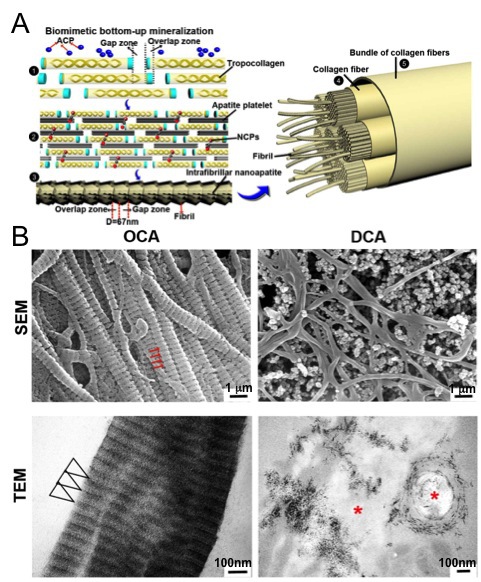
Methods: Ordered (OCA) and disordered (DCA) collagen/nanoapatite composites were separately fabricated by a bottom-up (Fig.1A) and top-down approach. Nanostructure was performed on unstained thin sections using a Tecnai G2 STEM. Nanomechanics was tested by atomic force microscopy under hydrated condition. Bone marrow stromal cells (BMSCs) were seeded on composites to investigate effects of nanostructure on cell behaviors. For in vivo experiments, composites were randomly implanted in rat mandible critical-size defects and the control group had no implants. The quantity and quality of newly-formed bone was evaluated eight weeks after implantation.
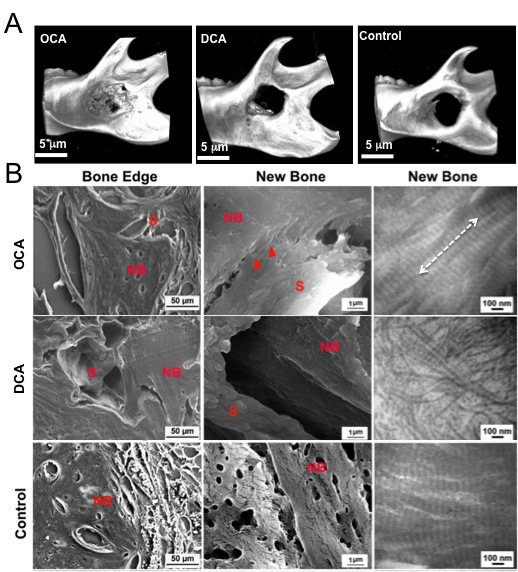
Results: In the OCA, fibrils were parallel-aligned with nanoapatites deposited in periodically-spaced gap zones; while fibrils were randomly-arranged with nanoapatites deposited around fibrils in the DCA (Fig.1B). Compared with the DCA, the OCA featured a significantly increased Young’s modulus and improved cell adhesion and proliferation, and calcification of BMSCs. In vivo experiments showed that the defects were entirely filled with bone structures with unidirectionally-aligned fibrils similar to natural bone in the OCA group (Fig.2). Limited bone formation restricted to defect margins with randomly-arranged fibrils in the DCA group and no obvious bone formation in the control group. Interestingly, the undegraded OCA integrated with regenerated bone. Immunohistochemistry displayed intensive expressions of TGF-b1 and VEGF in the OCA group.
Conclusions: The OCA reproducing nanoscale detail in natural bone serves as a support for ingrowth of host cells and participate directly in bone formation like a natural extracelluar matrix. This challenges the traditional concept of tissue engineering concept that scaffolds can only act as temporary templates.
Methods: Ordered (OCA) and disordered (DCA) collagen/nanoapatite composites were separately fabricated by a bottom-up (Fig.1A) and top-down approach. Nanostructure was performed on unstained thin sections using a Tecnai G2 STEM. Nanomechanics was tested by atomic force microscopy under hydrated condition. Bone marrow stromal cells (BMSCs) were seeded on composites to investigate effects of nanostructure on cell behaviors. For in vivo experiments, composites were randomly implanted in rat mandible critical-size defects and the control group had no implants. The quantity and quality of newly-formed bone was evaluated eight weeks after implantation.
Results: In the OCA, fibrils were parallel-aligned with nanoapatites deposited in periodically-spaced gap zones; while fibrils were randomly-arranged with nanoapatites deposited around fibrils in the DCA (Fig.1B). Compared with the DCA, the OCA featured a significantly increased Young’s modulus and improved cell adhesion and proliferation, and calcification of BMSCs. In vivo experiments showed that the defects were entirely filled with bone structures with unidirectionally-aligned fibrils similar to natural bone in the OCA group (Fig.2). Limited bone formation restricted to defect margins with randomly-arranged fibrils in the DCA group and no obvious bone formation in the control group. Interestingly, the undegraded OCA integrated with regenerated bone. Immunohistochemistry displayed intensive expressions of TGF-b1 and VEGF in the OCA group.
Conclusions: The OCA reproducing nanoscale detail in natural bone serves as a support for ingrowth of host cells and participate directly in bone formation like a natural extracelluar matrix. This challenges the traditional concept of tissue engineering concept that scaffolds can only act as temporary templates.
IMAGES
2105257_File000000.jpg
2105257_File000001.jpg
2105257_File000000.jpg
2105257_File000001.jpg