IADR Abstract Archives
Effect of Systemic Delivery of Substance P on the Periodontal Tissue Remodeling During Experimental Tooth Movement in Rats
Objectives: Objective: Orthodontic treatment is a process of periodontal tissue remodeling. Endogenous stem cell therapy is new strategy that mobilize endogenous stem/precursor cells to the site of injury without the need for cell seeding. And the new role of substance P as an injury-inducible messenger for mobilization MSC-like cells has been demonstrated. The purpose of this study is to examine the effect of systemic delivery of substance P on the periodontal tissue remodeling during experimental tooth movement.
Methods: Materials and Methods: 54 male Sprague Dawley rats were included in 3 groups: experimental group (tooth movement appliance and substance P injection), control group (tooth movement appliance and PBS injection) and blank group. The distance of the tooth movement was evaluated. The situation of periodontal tissue remodeling was detected by HE and immunohistochemistry staining. The level of IFN-γ and TNF-α in the periodontal tissue was studied.
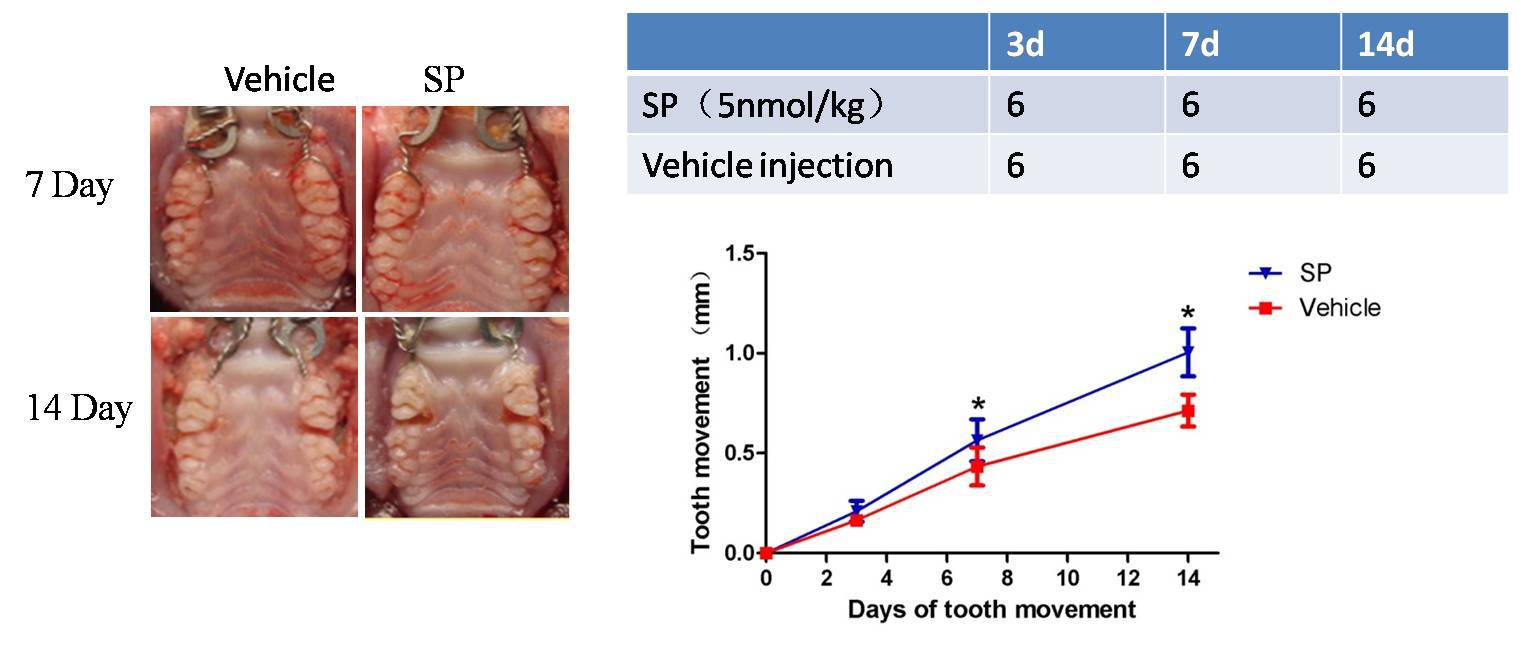
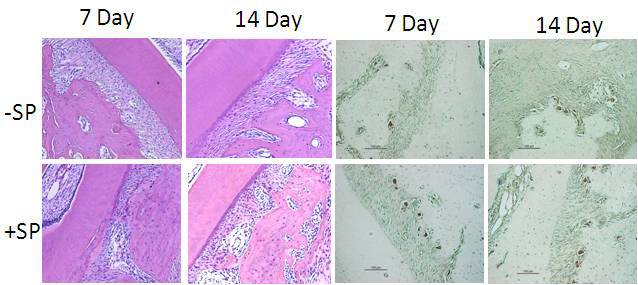
Results: Result: The results showed that systemic delivery of substance P could increase the distance of tooth movement. HE staining and TRAP staining revealed that systemic delivery of substance P could accelerate the bone deposition and bone resorption. The immunohistochemistry staining of osteocalcin revealed that systemic delivery of substance P could accelerate the expression of osteocalcin. And the level of IFN-γ and TNF-α in the periodontal tissue was reduced by systemic delivery of MSCs or substance P.
Conclusions: Conclusion: In this experiment systemic delivery of substance P accelerated the periodontal tissue remodeling during experimental tooth movement in rats.
Methods: Materials and Methods: 54 male Sprague Dawley rats were included in 3 groups: experimental group (tooth movement appliance and substance P injection), control group (tooth movement appliance and PBS injection) and blank group. The distance of the tooth movement was evaluated. The situation of periodontal tissue remodeling was detected by HE and immunohistochemistry staining. The level of IFN-γ and TNF-α in the periodontal tissue was studied.
Results: Result: The results showed that systemic delivery of substance P could increase the distance of tooth movement. HE staining and TRAP staining revealed that systemic delivery of substance P could accelerate the bone deposition and bone resorption. The immunohistochemistry staining of osteocalcin revealed that systemic delivery of substance P could accelerate the expression of osteocalcin. And the level of IFN-γ and TNF-α in the periodontal tissue was reduced by systemic delivery of MSCs or substance P.
Conclusions: Conclusion: In this experiment systemic delivery of substance P accelerated the periodontal tissue remodeling during experimental tooth movement in rats.
IMAGES
2099003_File000001.jpg
2099003_File000002.jpg
2099003_File000001.jpg
2099003_File000002.jpg