IADR Abstract Archives
Factors Affecting Light Transmission Through Resin-Composite During Polymerization
Objectives: Light activated resin based composites (RBC) must receive sufficient light in order to photopolymerize. Using response surface methodology, this study investigated the interaction of three factors that can affect the light transmission through the RBC during photocuring.
Methods: To determine the effect of RBC thickness, transmittance between 400-500nm (Tr400-500nm) and distance between the curing light and the distance between light and the top of the RBC, a 3-factor multivariable experiment was designed using response surface methodology. Each factor was varied at 5 levels. Experimental RBCs were prepared with transmittance 400-500nm values that ranged from 40 to 70. The RBCs were cured using an Elipar S-10 curing light (3M ESPE) in metal molds that ranged in thickness from 2 to 6mm. The Elipar S-10 light guide was placed 0 to 8mm above the composite. The light transmission through the RBC as it was light cured was recorded in real time into an integrating sphere (Labsphere) and the irradiance beam profile (Ophir Spiricon) was collected at the bottom of each RBC. The Knoop microhardness was also measured immediately light curing and after 24 hours on selected specimens.
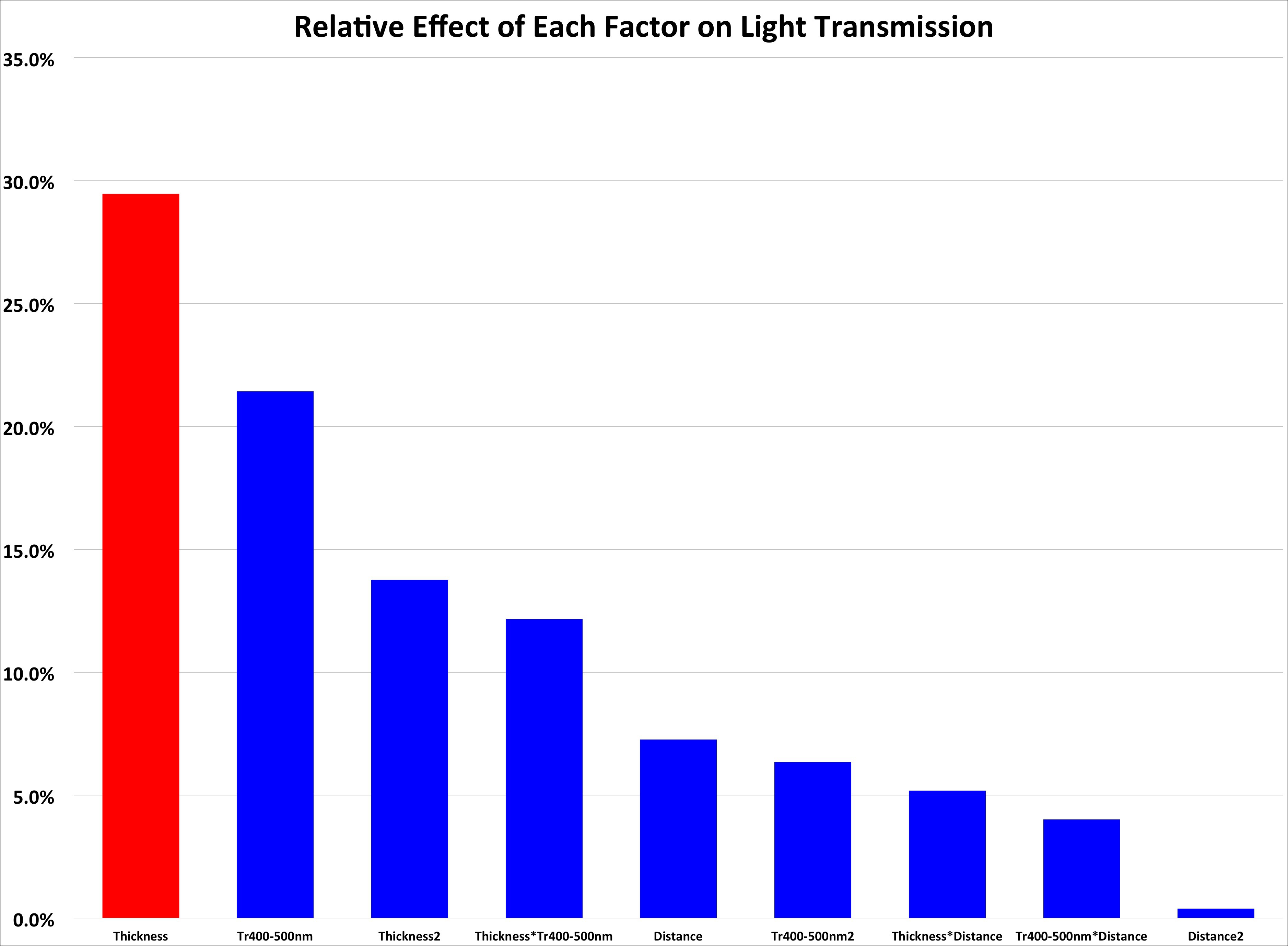
Results: The data were analyzed by multivariable regression in coded units. A full polynomial model was used to analyze the data and the use of coded units allowed for the comparison of the magnitude of the impact each factor had on the model. The polynomial model describing the experimental space fit the data with an R2=99.9% and a P-value described the significance of each factor. Thickness of the RBC had the greatest impact when determining the amount of light transmitted through the RBC as it was light cured. This finding was supported by the Knoop microhardness results obtained from selected specimens.
Conclusions: For the Elipar S10 curing light, the RBC thickness had the greatest impact on the amount of light transmitted through the RBC during light curing. The thickness was followed by Tr400-500nm > Thickness2 > Thickness*Tr400-500nm > Distance > Tr400-500nm2 > Thickness*Distance> Tr400-500nm*Distance >> Distance. Lights that deliver less homogeneous beam profiles may produce different results.
Methods: To determine the effect of RBC thickness, transmittance between 400-500nm (Tr400-500nm) and distance between the curing light and the distance between light and the top of the RBC, a 3-factor multivariable experiment was designed using response surface methodology. Each factor was varied at 5 levels. Experimental RBCs were prepared with transmittance 400-500nm values that ranged from 40 to 70. The RBCs were cured using an Elipar S-10 curing light (3M ESPE) in metal molds that ranged in thickness from 2 to 6mm. The Elipar S-10 light guide was placed 0 to 8mm above the composite. The light transmission through the RBC as it was light cured was recorded in real time into an integrating sphere (Labsphere) and the irradiance beam profile (Ophir Spiricon) was collected at the bottom of each RBC. The Knoop microhardness was also measured immediately light curing and after 24 hours on selected specimens.
Results: The data were analyzed by multivariable regression in coded units. A full polynomial model was used to analyze the data and the use of coded units allowed for the comparison of the magnitude of the impact each factor had on the model. The polynomial model describing the experimental space fit the data with an R2=99.9% and a P-value described the significance of each factor. Thickness of the RBC had the greatest impact when determining the amount of light transmitted through the RBC as it was light cured. This finding was supported by the Knoop microhardness results obtained from selected specimens.
Conclusions: For the Elipar S10 curing light, the RBC thickness had the greatest impact on the amount of light transmitted through the RBC during light curing. The thickness was followed by Tr400-500nm > Thickness2 > Thickness*Tr400-500nm > Distance > Tr400-500nm2 > Thickness*Distance> Tr400-500nm*Distance >> Distance. Lights that deliver less homogeneous beam profiles may produce different results.
IMAGES
2091059_File000000.jpg
2091059_File000000.jpg