IADR Abstract Archives
¿Es "Español" Español? Are Quality-of-Life Instruments Equivalent Across Borders
Objectives: The Child Oral Health Impact Profile-Short-Form (COHIP-SF19) is a comprehensive measure of children’s oral health-related quality-of-life (OHRQoL) with subscales “Oral Health”, “Functional”, and “Socio-Emotional” Well-being (Broder et al. 2012). Although the Spanish version was evaluated in a California pediatric population, its cross-cultural equivalence has not been assessed abroad. This study aimed to examine the psychometric properties of the Spanish COHIP-SF19 among Spanish-speaking children in Mexico (Tzucacab and Monterrey) and Peru (Lima).
Methods: COHIP-SF19 was administered to 1292 children aged 8-15 at 2 Mexican and 1 Peruvian cities. Confirmatory factor analysis (CFA) assessed fit of the published COHIP-SF19 3-factor model. Next, exploratory factor analysis (EFA; SAS PROC VARCLUS) of the 19 COHIP-SF items was conducted and the selected EFA model fit was assessed via CFA. Comparative Fit Index (CFI), Root Mean Squared Error of Approximation (RMSEA) and Standardized Root Mean Square Residual (SRMR) are indicators for model fit. Finally, internal consistency reliability of subscales was estimated by Cronbach’s alpha.
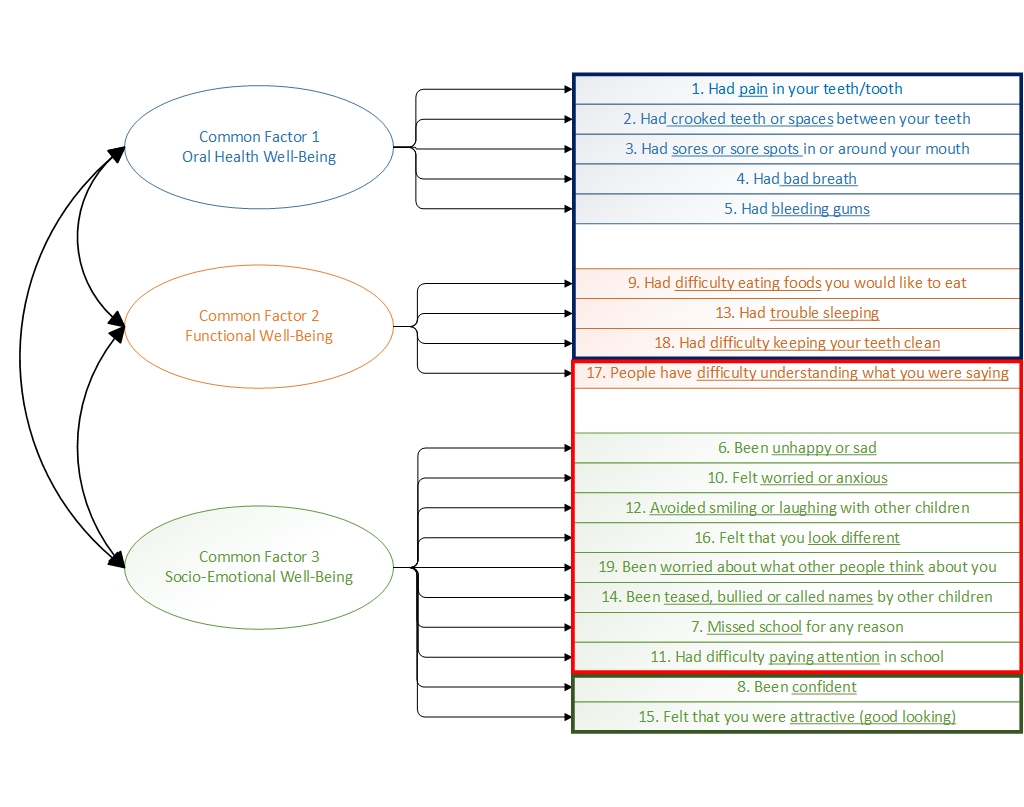
Results: The published 3-factor CFA model fit reasonably well (CFI=0.8124, RMSEA=0.0592, SRMR=0.0520; Hsu & Bentler, 1999). The EFA-identified 3-factor model fit slightly better (CFI=0.8553, RMSEA=0.0520, SRMR=0.0467). Nevertheless, EFA suggested item clusters that differed from those published: Oral Health items and 3 of 4 Functional items combined to form one factor, 8 of 10 Socio-Emotional items combined with 1 Functional item to form another factor, and two positively-worded items related to “Self-Image” (the fifth factor in the published 34-item COHIP) formed their own separate factor. Cronbach’s alphas of the published 3 subscales were 0.55-0.69.
Conclusions: Both the published and the EFA-identified models fit reasonably well, but the competing models had differing factor interpretations in non-US Spanish-speaking study populations. Further investigation is required to refine a psychometrically sound OHRQoL instrument for school-aged populations in the context of different cultures.
Methods: COHIP-SF19 was administered to 1292 children aged 8-15 at 2 Mexican and 1 Peruvian cities. Confirmatory factor analysis (CFA) assessed fit of the published COHIP-SF19 3-factor model. Next, exploratory factor analysis (EFA; SAS PROC VARCLUS) of the 19 COHIP-SF items was conducted and the selected EFA model fit was assessed via CFA. Comparative Fit Index (CFI), Root Mean Squared Error of Approximation (RMSEA) and Standardized Root Mean Square Residual (SRMR) are indicators for model fit. Finally, internal consistency reliability of subscales was estimated by Cronbach’s alpha.
Results: The published 3-factor CFA model fit reasonably well (CFI=0.8124, RMSEA=0.0592, SRMR=0.0520; Hsu & Bentler, 1999). The EFA-identified 3-factor model fit slightly better (CFI=0.8553, RMSEA=0.0520, SRMR=0.0467). Nevertheless, EFA suggested item clusters that differed from those published: Oral Health items and 3 of 4 Functional items combined to form one factor, 8 of 10 Socio-Emotional items combined with 1 Functional item to form another factor, and two positively-worded items related to “Self-Image” (the fifth factor in the published 34-item COHIP) formed their own separate factor. Cronbach’s alphas of the published 3 subscales were 0.55-0.69.
Conclusions: Both the published and the EFA-identified models fit reasonably well, but the competing models had differing factor interpretations in non-US Spanish-speaking study populations. Further investigation is required to refine a psychometrically sound OHRQoL instrument for school-aged populations in the context of different cultures.
IMAGES
2080843_File000000.jpg
2080843_File000000.jpg