IADR Abstract Archives
The Erosive/Abrasive Challenge of Bovine, Human and Ovine Enamel
Objectives: This study aimed to test the null hypothesis that there are no significant differences in surface characteristics of eroded and abraded human, ovine and bovine enamel specimens.
Methods: Twenty enamel slabs were prepared from bovine, human and ovine incisor crowns and embedded in acrylic. Samples were polished with 3 µm aluminium oxide paste and then assigned to one of 4 treatments: i) 30 second immersion at 1% w/v citric acid ii) 4 minute immersion at 1% w/v citric acid iii) 30 second immersion at 6% w/v citric acid and iv) 4 minute immersion at 6% w/v citric acid. Post-erosion, an oscillatory brush was used with a force of 200g for 20 seconds. Roughness average (Ra), bearing parameters (MR1, MR2, Rpk, Rk, Rvk), surface microhardness and scanning electron microscopy (SEM) were used to compare the different tissues. The maximum height change in the profile was also measured from the acrylic reference layer.
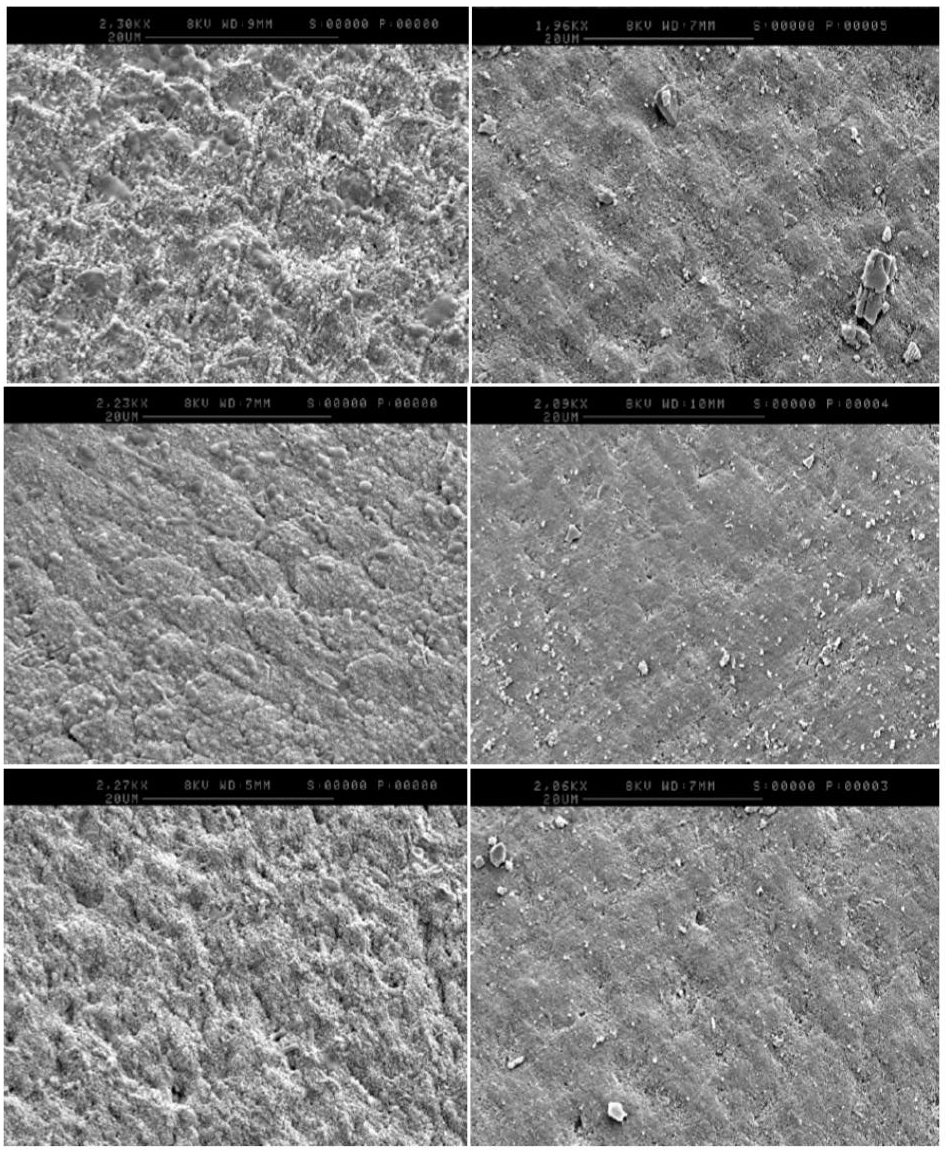
Results: Whilst the eroded surface became generally less rough after the abrasive challenge, there were significant tissue differences for Ra/Rk/Rpk/Rvk and MR1 values. Abraded microhardness was significantly increased compared to baseline eroded values (P < 0.001), with bovine enamel recording the hardest enamel and ovine the softest. Surface loss was significantly different between tissue types (P < 0.001); ovine enamel recorded the largest loss, and bovine the smallest. Typical SEM images of eroded and then subsequently abraded human, ovine and bovine enamel at high magnification show significant differences for each tissue that are consistent with the quantitative data.
Conclusions: The null hypothesis was rejected; ovine enamel displayed little correlation with human enamel when subjected to erosive and abrasive challenges. Bovine enamel showed similar trends to human enamel but was consistently harder and more resistant to surface change. Therefore bovine enamel cannot be reliably used interchangeably with human enamel for erosion and abrasion studies.
Methods: Twenty enamel slabs were prepared from bovine, human and ovine incisor crowns and embedded in acrylic. Samples were polished with 3 µm aluminium oxide paste and then assigned to one of 4 treatments: i) 30 second immersion at 1% w/v citric acid ii) 4 minute immersion at 1% w/v citric acid iii) 30 second immersion at 6% w/v citric acid and iv) 4 minute immersion at 6% w/v citric acid. Post-erosion, an oscillatory brush was used with a force of 200g for 20 seconds. Roughness average (Ra), bearing parameters (MR1, MR2, Rpk, Rk, Rvk), surface microhardness and scanning electron microscopy (SEM) were used to compare the different tissues. The maximum height change in the profile was also measured from the acrylic reference layer.
Results: Whilst the eroded surface became generally less rough after the abrasive challenge, there were significant tissue differences for Ra/Rk/Rpk/Rvk and MR1 values. Abraded microhardness was significantly increased compared to baseline eroded values (P < 0.001), with bovine enamel recording the hardest enamel and ovine the softest. Surface loss was significantly different between tissue types (P < 0.001); ovine enamel recorded the largest loss, and bovine the smallest. Typical SEM images of eroded and then subsequently abraded human, ovine and bovine enamel at high magnification show significant differences for each tissue that are consistent with the quantitative data.
Conclusions: The null hypothesis was rejected; ovine enamel displayed little correlation with human enamel when subjected to erosive and abrasive challenges. Bovine enamel showed similar trends to human enamel but was consistently harder and more resistant to surface change. Therefore bovine enamel cannot be reliably used interchangeably with human enamel for erosion and abrasion studies.
IMAGES
2062898_File000000.jpg
2062898_File000000.jpg