IADR Abstract Archives
Akt is a Key Modulator in TGF-β1-Induced Osteoblast Differentiation
Objectives: Transforming growth factor-beta 1 (TGF-β1) is one of the anti-inflammatory cytokines produced in the presence of inflammation such as periodontitis. Although a pivotal role in the bone-remodeling process has been assigned to TGF-β1, excessive TGF-β1 production can also inhibit osteoblast differentiation. We have previously reported that IGF-1/PI3K signaling plays an important role in TGF-β1-induced osteoblast differentiation; however, the downstream signaling controlling this remains unknown. The aim of this study is to investigate the role of Akt activation in TGF-β1-induced osteoblast differentiation.
Methods: Preosteoblast MC3T3-E1 cells were cultured in osteoblast differentiation medium (OBM) with or without TGF-β1. OBM containing TGF-β1 was changed every 12 h to provide repeated TGF-β1 administration. The cells were also treated with IGF-1 as indicated. MC3T3-E1 cells were infected with retroviral vectors expressing constitutively active (CA) or dominant-negative (DN)-Akt. The degree of osteoblast differentiation was analyzed by alkaline phosphatase (ALP) activity and mRNA expression of osteoblast differentiation markers. Protein expression was assessed by Western blot.
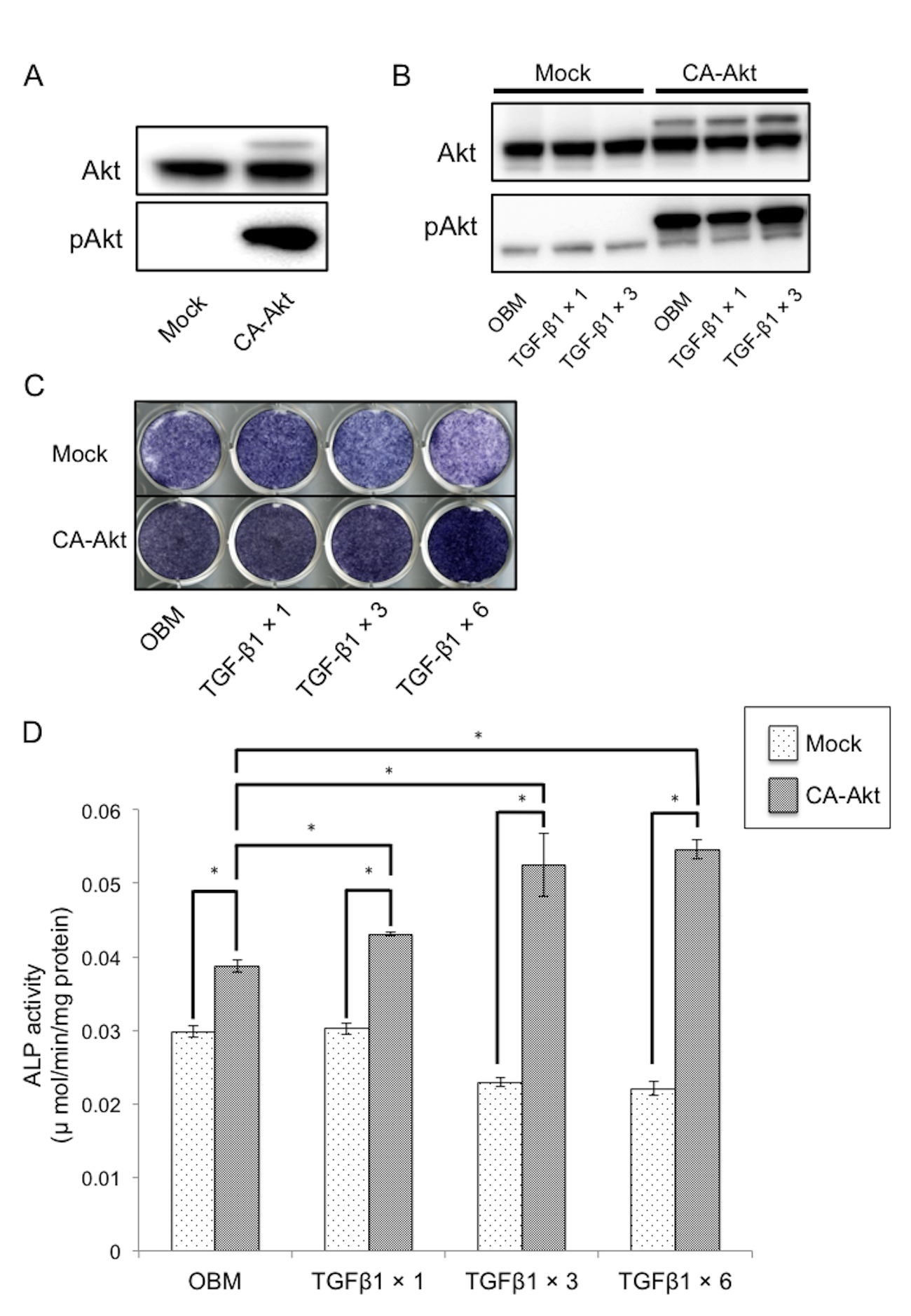
Results: ALP activity and osteoblastic marker mRNA levels were significantly decreased by repeated TGF-β1 treatment compared with a single TGF-β1 treatment. Expression of CA-Akt restored ALP activity following TGF-β1 treatment, and ALP activity increased following multiple TGF-β1 treatments as the number of administrations of TGF-β1 increased (p < 0.001). Exogenous IGF-1 restored the down-regulation of osteoblast-related gene expression by repeated TGF-β1 administration. However, in cells expressing DN-Akt, these levels remained inhibited regardless of IGF-1 treatment. CA-Akt enhanced the phosphorylation of Erk1/2 and Smad3.
Conclusions: These results indicated that TGF-β1 regulates osteoblast differentiation via IGF-1/PI3K/Akt signaling, and TGF-β1 could be an inducer or an inhibitor of osteoblastic differentiation of MC3T3-E1 cells depending on Akt activation. The activation of Akt may therefore be a useful treatment approach for bone regeneration in inflammatory disease.
Methods: Preosteoblast MC3T3-E1 cells were cultured in osteoblast differentiation medium (OBM) with or without TGF-β1. OBM containing TGF-β1 was changed every 12 h to provide repeated TGF-β1 administration. The cells were also treated with IGF-1 as indicated. MC3T3-E1 cells were infected with retroviral vectors expressing constitutively active (CA) or dominant-negative (DN)-Akt. The degree of osteoblast differentiation was analyzed by alkaline phosphatase (ALP) activity and mRNA expression of osteoblast differentiation markers. Protein expression was assessed by Western blot.
Results: ALP activity and osteoblastic marker mRNA levels were significantly decreased by repeated TGF-β1 treatment compared with a single TGF-β1 treatment. Expression of CA-Akt restored ALP activity following TGF-β1 treatment, and ALP activity increased following multiple TGF-β1 treatments as the number of administrations of TGF-β1 increased (p < 0.001). Exogenous IGF-1 restored the down-regulation of osteoblast-related gene expression by repeated TGF-β1 administration. However, in cells expressing DN-Akt, these levels remained inhibited regardless of IGF-1 treatment. CA-Akt enhanced the phosphorylation of Erk1/2 and Smad3.
Conclusions: These results indicated that TGF-β1 regulates osteoblast differentiation via IGF-1/PI3K/Akt signaling, and TGF-β1 could be an inducer or an inhibitor of osteoblastic differentiation of MC3T3-E1 cells depending on Akt activation. The activation of Akt may therefore be a useful treatment approach for bone regeneration in inflammatory disease.
IMAGES
2072292_File000000.jpg
2072292_File000000.jpg